What Happens After Clearing CSS Written Exams? Complete Interview Prep Guide
Clearing the CSS written examination is the part everyone talks about. It is the visible achievement, the headline. In CSS 2024, only 354 out of 12,792 candidates cleared the written stage. If you are reading this as one of them, you have done what 97 percent of the field could not.
What almost nobody talks about is what comes after. And what comes after is harder than most cleared candidates realise.
The viva voce is worth 300 marks. The minimum passing requirement is 100. A high written score does not protect you here. Historical data from FPSC's other examinations is instructive: in the SOPE 2017 cycle, 74 percent of candidates who cleared the written stage were disqualified at the interview. Civil service exams across South Asia repeatedly show this pattern. Prepared candidates with strong written performance underestimate the post-written stages and pay for it.
This guide walks through every stage between clearing the written exam and being allocated to a service group. The information is drawn from FPSC's official rules, the CSS Competitive Examination Rules 2019 as amended, and the experience of candidates who navigated this stage successfully.
The Complete Sequence After Written Result
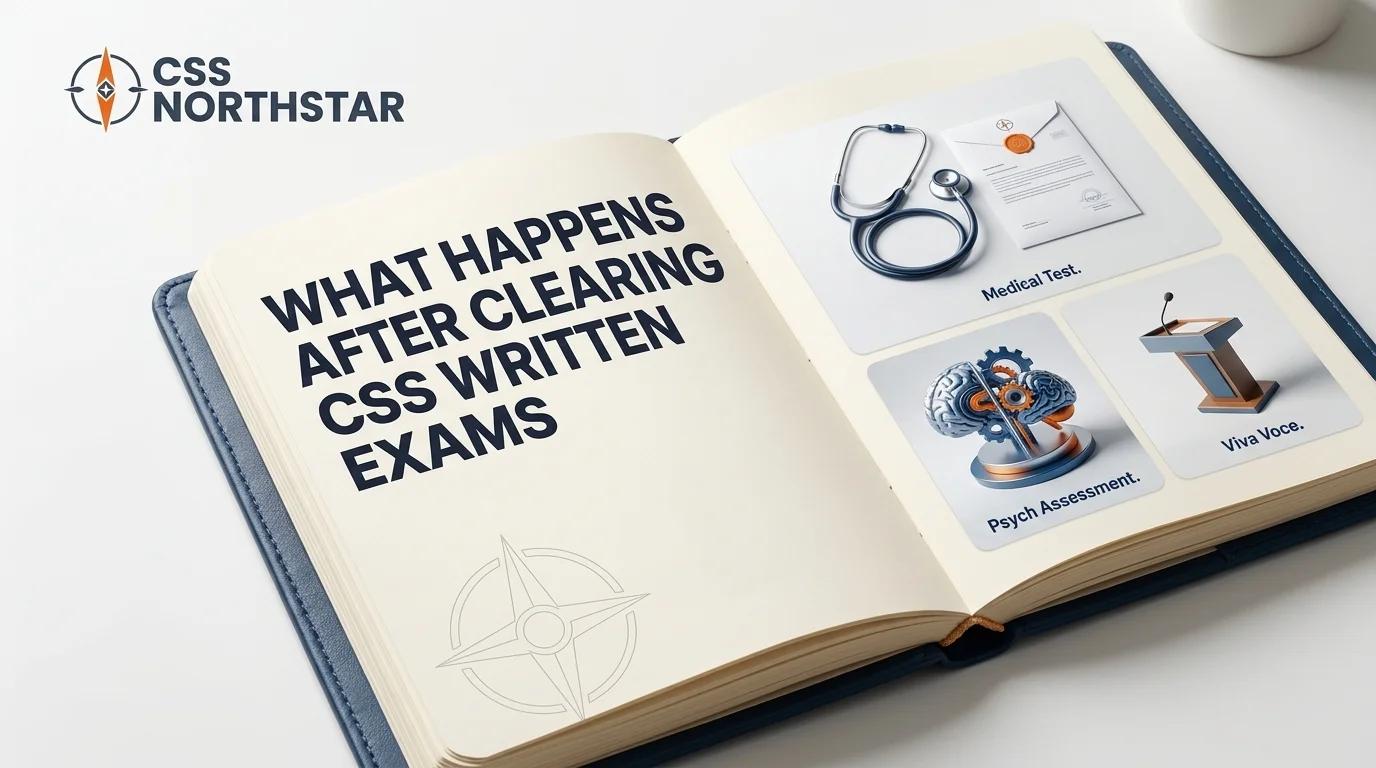
When FPSC announces the written result, qualified candidates begin a multi-stage process that typically spans several months. The standard sequence is:
- Written exam result announcement by FPSC, usually 5 to 7 months after the written exam
- Psychological assessment at FPSC regional offices (Islamabad, Lahore, Karachi, Peshawar, Quetta), conducted over a full working day
- Viva voce interview before an FPSC board, typically 20 to 30 minutes
- Medical examination by an FPSC-appointed medical board
- Final merit list published by FPSC
- Service group allocation based on merit and candidate preferences
- Common Training Programme at Civil Services Academy Lahore (six months)
- Specialised training by allocated service group
- First posting as a BPS-17 officer
Each stage is mandatory. Missing or failing any single stage removes you from the process for that exam cycle. There is no recovery within the same year.
Stage 1: The Psychological Assessment
This is the stage almost every cleared candidate underprepares for, partly because FPSC itself says no preparation is required. That advice is partially true and partially misleading. Let me explain both parts.
What the Psychological Assessment Actually Covers
The full-day assessment includes multiple components:
Written ability tests. These measure verbal reasoning, numerical reasoning, and abstract reasoning. They are similar in format to standardised aptitude tests and they do reward practice. The verbal section tests vocabulary, analogies, and reading comprehension. The numerical section tests basic arithmetic, data interpretation, and quantitative reasoning. The abstract reasoning section tests pattern recognition.
Personality assessment. This is a self-report inventory measuring personality traits relevant to civil service work: emotional stability, conscientiousness, openness, decision-making style, stress response. FPSC's advice to "just be yourself" applies here. Attempting to game personality assessments tends to produce inconsistent profiles that flag as unreliable.
Group activities. Candidates are placed in small groups and given a topic to discuss or a scenario to resolve. Psychologists observe how candidates contribute, whether they dominate or recede, how they handle disagreement, and whether they demonstrate leadership without aggression. This is the component where candidates lose the most ground without realising it.
Individual interview with psychologists. A one-on-one conversation with the assessment panel where they clarify your responses, probe inconsistencies, and ask about your background, motivations, and self-perception.
What FPSC Says About Preparation
FPSC's official position is that no preparation is required. The reasoning is that the assessment is designed to evaluate genuine personality traits rather than rehearsed answers. Attempting to perform a persona produces an inconsistent profile that the psychologists will detect.
What You Can Genuinely Prepare
Within FPSC's guidance, several things are worth doing:
Practise the aptitude components. The verbal, numerical, and abstract reasoning tests reward familiarity with the format. Working through standard aptitude practice books in the weeks before the assessment improves your score without compromising the "be yourself" principle.
Develop group discussion skills. This is the single highest-yield preparation. Most CSS aspirants come from academic backgrounds where they have rarely participated in structured group discussions. Practise with peers. Learn to contribute substantively without dominating. Learn to disagree with grace. Learn to bring quieter participants into the discussion. These are observable behaviours that psychologists score.
Sleep well the night before. The assessment runs a full working day. Mental fatigue noticeably degrades performance on the aptitude components and produces irritability in the group activities. Candidates who treat this as a casual day perform measurably worse than candidates who prepare for it as they would for a working interview.
Read about civil service work. The interview component touches on motivations and self-perception, and candidates who have a substantive, considered view of what civil service work actually involves come across as more credible than candidates who give rehearsed platitudes.
Critical Rule
Absence from the psychological assessment results in automatic disqualification from the viva voce. There is no make-up date and no exception. FPSC's official position is unambiguous on this.
Stage 2: The Viva Voce
This is the 300-mark interview that determines, more than any other single component, whether you receive a service allocation and which service group you enter.
The Board and What They Have
The viva voce is conducted by a panel of FPSC members and external experts. The composition typically includes senior bureaucrats, retired officers, academics, and subject specialists. The board has on the table before you arrive:
- Your complete academic record from matriculation onward
- Your CSS application form and personal information
- Your declared hobbies, interests, and extracurricular activities
- Your selected optional subjects
- Your written exam performance
This is not a getting-to-know-you conversation. The board has studied your file. They know what you have claimed about yourself and they will test it.
What Gets Asked
The viva voce covers a wider range than most candidates expect. Common areas include:
Your declared interests. If you stated that your hobby is reading and you mentioned a specific author, expect questions about that author's themes, work, and significance. Candidates who list interests they cannot defend are penalised heavily. The board interprets unsupported claims as a character signal, not just a knowledge gap.
Your optional subjects. You will be questioned on the subjects you selected, particularly on contemporary applications and recent developments. A candidate who selected International Relations should expect detailed questions on current geopolitical developments. A candidate who selected Constitutional Law should expect questions on recent judgments and pending constitutional issues.
Current affairs. National and international developments from the past six to twelve months are standard material. The board may ask about a specific policy decision, a recent diplomatic exchange, or an economic event, and follow up on your analytical view rather than just the facts.
Pakistan-related knowledge. Geography, history, political system, constitutional structure, federal-provincial relations, contemporary issues. This is general baseline knowledge for any civil servant.
Islamic studies for Muslim candidates. Non-Muslim candidates are exempt from this component. For Muslim candidates, basic Islamic concepts, the prophetic tradition, and Islamic history are standard areas.
Situational and hypothetical scenarios. "If you were posted as DC of a district and faced this situation, how would you handle it?" These questions test judgment, not knowledge. There is no single correct answer. The board is observing your reasoning, your awareness of constraints, and your ethical framework.
What the Board Is Actually Measuring
The 300 marks are not awarded for factual recall. The board is measuring:
- Moral character and integrity. Whether your answers reflect a coherent ethical framework or shift conveniently
- Presence of mind. How you handle a question you do not know the answer to
- Intelligence and analytical ability. Whether you can reason through a problem in real time
- Strength of character. Whether you can hold a considered position under questioning without becoming defensive
- Leadership potential. Whether you demonstrate the temperament expected of a civil servant
- Communication skill. Whether you can express complex ideas clearly under pressure
A candidate who admits "I do not know the answer to that, but my view on the underlying issue is..." typically scores better than a candidate who fabricates an answer. The board has seen every variation of bluffing and recognises it instantly.
The 100-Mark Threshold
The minimum passing mark for the viva voce is 100 out of 300. A candidate who scores below 100 in the viva voce, regardless of their written performance, does not receive a service allocation. This is the threshold that disqualifies a significant number of candidates each year.
Dress Code
FPSC has published specific guidance. Formal dress is expected. T-shirts, jeans, and denims are not acceptable. Male candidates without a beard must be freshly shaved. Female candidates should adhere to cultural traditions in their presentation. This is not stylistic preference. Inappropriate dress signals lack of seriousness and reportedly affects scoring.
Stage 3: Medical Examination
After the viva voce, qualified candidates undergo a medical examination conducted by an FPSC-appointed medical board.
What Is Examined
Vision, hearing, height, weight, blood pressure, general physical fitness, and standard laboratory tests including blood work and chest X-ray. The examination is comprehensive.
Service Group Implications
Different service groups have different medical standards.
PAS (Pakistan Administrative Service) and PSP (Police Service of Pakistan) have the strictest physical standards, including vision requirements that may disqualify candidates from these specific groups even if they remain eligible for other allocations.
Secretariat groups such as OMG (Office Management Group) and Information Group have more relaxed medical standards.
A candidate who clears the viva voce but fails the medical examination for their preferred service group may still be allocated to a different group for which they meet the medical standards. Outright disqualification from all groups requires failure of baseline medical fitness.
Preparation
Candidates with known medical conditions should consult an independent medical examiner well before the FPSC medical board, to understand whether their condition will affect allocation. There is no benefit to discovering an issue at the FPSC stage.
Stage 4: Service Group Allocation
The final merit list is published after the medical stage. Allocation to one of twelve service groups follows.
The Twelve Service Groups
Pakistan Administrative Service (PAS), Police Service of Pakistan (PSP), Foreign Service of Pakistan (FSP), Pakistan Audit and Accounts Service, Inland Revenue Service (IRS), Customs Service, Information Group, Postal Group, Railways Commercial and Transportation Group, Office Management Group (OMG), Military Lands and Cantonments Group, and Commerce and Trade Group.
How Allocation Actually Works
Allocation is based on the candidate's final merit position combined with their service group preferences. Candidates submit a ranked preference list. FPSC matches candidates to groups by going down the merit list and allocating each candidate to their highest available preference based on the seats available for their domicile quota.
Two implications of this system:
The top of the merit list gets first pick. Candidates ranked highest can secure their preferred group, which for many is PAS or PSP.
Domicile matters at this stage too. Each service group has province-wise quota allocations. A candidate with a Balochistan domicile may secure a service group at a merit position that would not have been competitive for a Punjab domicile candidate, because the Balochistan quota for that group competes against a smaller pool.
This is why subject selection and quota planning earlier in the journey continue to matter through to allocation. The CSSNorthstar assessment calculates allocation probability for your target service group based on your specific domicile and predicted merit position, which is information no academy can provide.
Stage 5: Common Training Programme
Allocated officers proceed to the Civil Services Academy in Lahore for a six-month Common Training Programme. This is the foundational training shared across all service groups before specialised training begins. Officers train together regardless of their allocated group during this phase, which builds inter-service relationships that matter throughout their careers.
After common training, officers move to their group-specific training institute for further specialisation before their first field posting as BPS-17 officers.
How to Actually Prepare for the Interview Stage
The single most useful preparation activity for the viva voce is structured mock interviews with experienced bureaucrats or academics who understand the format. If you have access to this through your network, take it. If you do not, the next best alternatives are:
Mock interviews with cleared candidates. Officers who recently went through the process remember the specific questions and pressure points. Their feedback is more current than that of officers from earlier batches.
Group study with other cleared candidates. Practise discussing current affairs in a small group setting. This replicates the group discussion component of the psychological assessment and sharpens your ability to articulate considered views under questioning.
Substantive current affairs revision. Not surface-level news consumption. Deep engagement with the major national and international issues of the past year. Be able to defend a considered view, not just recite facts.
Honest review of your own application. Every hobby, interest, and activity you declared is a question the board may ask. If you cannot defend a claim, remove it or be ready to address it honestly.
The Mistakes That Eliminate Prepared Candidates
After studying this stage for years and observing what happens to cleared candidates, the consistent failure patterns are these:
Underpreparing the psychological assessment on the assumption that FPSC's "be yourself" advice means no work is required. The aptitude components reward practice and the group discussion component rewards structured social skill.
Listing impressive-sounding hobbies on the application that the candidate cannot actually defend under questioning. The board treats this as a character signal.
Bluffing through unfamiliar questions rather than acknowledging the limit of their knowledge. Boards detect this immediately and penalise it heavily.
Treating dress and presentation as cosmetic. FPSC's published dress code reflects a serious institutional expectation that candidates demonstrate respect for the process.
Underpreparing for situational scenarios. Many candidates prepare facts but not judgment. Situational questions cannot be cracked with facts alone and require advance thinking about how a civil servant should reason through real problems.
What Comes Next
If you are reading this as a written-qualified candidate preparing for the interview stage, the most useful thing you can do in the available time is build the judgment and presence that the board is actually measuring, rather than cramming more facts. The exam has already tested your knowledge. The interview is testing whether you have the character for the work.
For aspirants who are still earlier in the journey, the strategic decisions you make about subject selection and quota planning now will affect your final merit position and your allocation prospects later. The CSSNorthstar assessment uses six years of FPSC data to make these decisions properly. The candidates who make the right choices at the start of preparation are the candidates who reach the viva stage with the merit position that gives them genuine choice of service group.
The written exam clears the gate. The interview decides what you do on the other side of it.

Sheharyar Ahmad
Founder, CSSNorthstar
Sheharyar Ahmad graduated from LUMS with BSc. (Hons.) in 2010 and topped the CSS Exam 2012 on his first attempt. He is an officer of the Pakistan Administrative Service, having served in Gilgit-Baltistan, Punjab, and Federal governments. He was awarded the Fulbright Scholarship to pursue a Master in Public Policy and Data Analytics from USA in 2022.