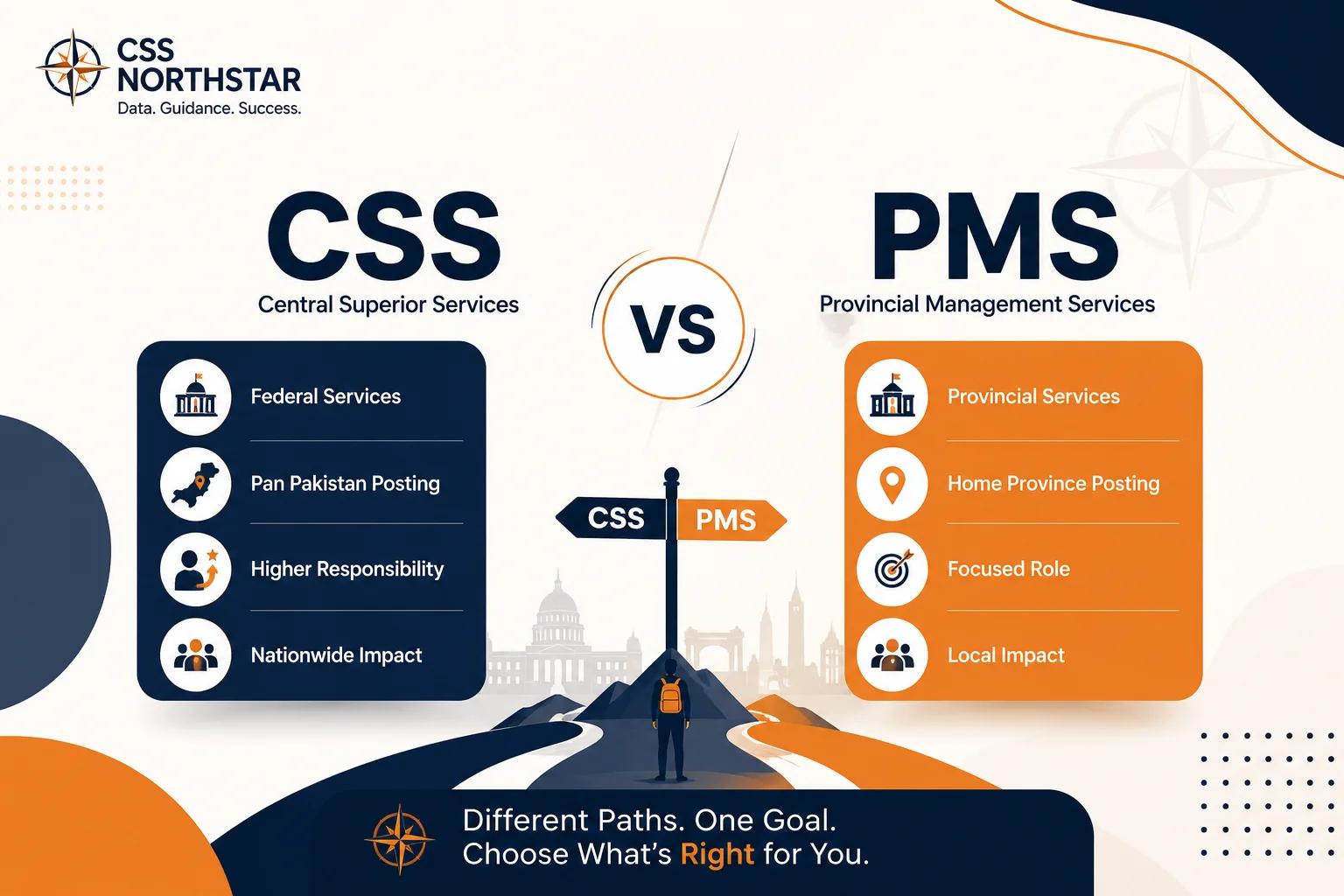
If you are a fresh graduate or a working professional thinking about entering Pakistan's civil services, there is one question that comes up before anything else. Should I prepare for CSS or PMS? Both exams open doors to prestigious government careers. Both put you at BPS-17. Both carry genuine respect in society. But they are fundamentally different in scope, structure, career trajectory, and daily reality once you clear them.
This is the comparison I wish someone had given me in plain language before I started my own CSS journey. No filler, no motivational quotes. Just facts and honest analysis so you can make the right call for your situation.
What Is CSS?
CSS stands for Central Superior Services. It is Pakistan's premier competitive examination, conducted annually by the Federal Public Service Commission (FPSC). Successful candidates are allocated to one of 12 federal occupational groups and posted anywhere in Pakistan or abroad, depending on their service group.
The exam has three stages. First, an MCQ-based screening test called the MPT (Multiple Paper Test). Candidates who clear the MPT qualify for the written examination, which carries 1,200 marks across 12 papers. Those who pass the written stage then face a viva voce (interview) worth 300 marks. Final allocation to a service group depends on aggregate merit, stated preferences, and provincial quota.
The pass rate hovers around 2 to 3 percent. Out of roughly 15,000 candidates who sit for the written exam each year, only 350 to 400 are recommended for service groups. This is not a statistic meant to intimidate you. It is meant to calibrate your expectations and preparation intensity.
What Is PMS?
PMS stands for Provincial Management Service. It is the provincial equivalent of CSS, conducted separately by each province's Public Service Commission. PPSC handles Punjab, SPSC handles Sindh, KPPSC handles Khyber Pakhtunkhwa, and BPSC handles Balochistan.
Successful PMS candidates serve within their home province. They are appointed to roles like Assistant Commissioner, Section Officer, and various administrative positions under the provincial government. The career remains within the provincial civil secretariat and district administration.
The exam structure varies by province, but generally includes a written examination of 1,200 marks followed by an interview. PMS Punjab, for example, includes a General Knowledge MCQs paper as a compulsory subject and requires candidates to choose three optional subjects of 200 marks each.
The Core Difference in One Line
CSS is federal. You compete at the national level and can be posted anywhere in Pakistan or abroad. PMS is provincial. You compete within your province and your entire career stays inside that province.
Everything else flows from this single distinction.
Side-by-Side Comparison
Conducting Body
CSS is conducted by the Federal Public Service Commission (FPSC), headquartered in Islamabad. PMS is conducted by the respective Provincial Public Service Commission of your province. Different commissions mean different rules, different timelines, and sometimes different syllabus structures.
Eligibility and Age Limit
Both exams require a minimum Bachelor's degree with at least second division from an HEC-recognized university. Candidates with a third division in their bachelor's can still qualify if they hold a first or second division at the master's level.
For CSS, the National Assembly passed a resolution in May 2025 to increase the upper age limit from 30 to 35 years and raise maximum attempts from 3 to 5, effective from 2026. However, the implementation status by FPSC has been a source of confusion. Some official sources reflect the updated limit while others still reference the older rules. If you are planning to apply, verify the current age limit directly on fpsc.gov.pk before submitting your application.
For PMS, the age limit generally ranges from 21 to 30 years, though this varies by province. PPSC, SPSC, KPPSC, and BPSC each set their own age relaxation rules. Provincial government employees typically receive 2 years of relaxation.
Exam Structure
CSS has three stages. The MPT screening test comes first. Those who clear the MPT proceed to the written examination, which consists of 6 compulsory papers and 6 optional papers, each carrying 100 marks, for a total of 1,200 marks. The final stage is the viva voce interview worth 300 marks, bringing the total to 1,500 marks.
The six compulsory subjects for CSS are English Essay, English Precis and Composition, General Science and Ability, Current Affairs, Pakistan Affairs, and Islamiyat (or an alternative for non-Muslim candidates). Optional subjects are selected one from each of seven groups, covering everything from Political Science and Economics to Pure Mathematics and regional languages.
PMS structure varies by province. PMS Punjab, for instance, does not include Current Affairs and General Science and Ability as separate compulsory subjects the way CSS does. It includes a General Knowledge MCQs paper instead. Candidates choose three optional subjects of 200 marks each. The total written marks are 1,200, and the interview carries 200 marks.
The paper pattern also differs. CSS papers follow a set format with 20 marks for objective questions and 80 marks for subjective questions within each paper. PMS Punjab papers tend to be fully subjective in optional subjects, with five questions of 20 marks each.
Service Groups and Career Path
This is where the difference becomes most tangible in daily life.
CSS qualifiers are allocated to one of 12 federal occupational groups based on merit. The most sought-after groups include Pakistan Administrative Service (PAS, formerly DMG), Police Service of Pakistan (PSP), Foreign Service of Pakistan (FSP), Inland Revenue Service (IRS), Commerce and Trade Group, and Customs and Excise. In CSS 2025, all top 30 position holders were allocated to PAS and PSP.
A CSS officer enters at BPS-17 and can rise to BPS-22 (Federal Secretary level). The career involves national-level policymaking, district administration, diplomatic postings, revenue collection, and policing across all provinces.
PMS qualifiers serve in the provincial civil secretariat and district administration. Roles include Assistant Commissioner, Section Officer, DSP (in some provinces), and various administrative posts within provincial departments. Promotion ceiling is generally BPS-20 or BPS-21 (Provincial Secretary level), though top posts are often filled by CSS officers on deputation.
This is an important reality to understand. In most provinces, the highest administrative positions (Commissioner, Deputy Commissioner in some cases) are held by PAS officers from the CSS cadre. PMS officers can and do reach senior positions, but the career ceiling is structurally lower.
Posting and Lifestyle
CSS officers must be willing to serve anywhere in the country. Your first posting as an Assistant Commissioner could be in a remote district in Balochistan even if you are from Lahore. FSP officers are posted to Pakistani embassies worldwide. This mobility is both a privilege and a demand on personal life.
PMS officers remain in their home province for their entire career. If stability, proximity to family, and predictability matter to you, this is a significant advantage. You know where you will live and work. There are no surprise transfers across the country.
Competition Level
CSS is significantly more competitive. The national-level candidate pool is larger, the pass rate is lower, and the preparation demands are higher. The syllabus is broader with 12 papers. The MPT screening stage alone eliminates a large percentage of applicants before they even reach the written exam.
PMS, while still competitive, operates at the provincial level with a smaller candidate pool. The pass rate is generally higher than CSS. Many candidates and coaching academies consider PMS slightly more accessible, though "easier" would be an overstatement.
Syllabus Overlap
This is actually good news for serious aspirants. The compulsory subjects overlap heavily between CSS and PMS. English Essay, English Precis and Composition, Pakistan Affairs, and Islamiyat are common to both exams. Many popular optional subjects like Political Science, Public Administration, Sociology, and Psychology also appear in both syllabi, though the depth and specific topics may differ.
This overlap means that if you prepare seriously for CSS, you are simultaneously preparing for a large portion of PMS. Many experienced aspirants apply for both exams in the same cycle, treating PMS as a parallel track alongside CSS preparation.
Which Exam Is Right for You?
There is no universally correct answer. The right choice depends on your career ambitions, personal circumstances, and honest self-assessment.
Choose CSS if you want a career with national and international scope
CSS is the right path if you want to serve at the federal level with the broadest possible impact. If the idea of serving as a District Commissioner in a different province, shaping national policy in Islamabad, or representing Pakistan in a foreign capital excites you, CSS is where those opportunities exist. You should be comfortable with uncertainty about where you will live, willing to invest 1 to 2 years of intensive full-time preparation, and ready for the reality that the pass rate is under 3 percent.
Choose PMS if you want a strong government career within your province
PMS is the right path if you want a respected administrative career while staying in your home province. If proximity to family is a priority, if you prefer a more predictable career trajectory, or if you want to focus on provincial governance and local development, PMS delivers exactly that. The preparation intensity is still significant, but the scope is more manageable and the competition somewhat less fierce.
Consider preparing for both simultaneously
This is the strategy I recommend to most serious aspirants. The compulsory subject overlap between CSS and PMS is substantial enough that preparing for one naturally prepares you for the other. Many candidates who eventually clear CSS also attempted PMS along the way. It keeps you in examination mode, gives you real experience with the competitive exam environment, and provides a genuine fallback with real career value.
If PMS is conducted in your province before CSS, sit for it. Treat it as both preparation and a parallel opportunity. There is no downside to this approach as long as you do not dilute your CSS preparation to accommodate PMS-specific content.
How CSSNorthstar Helps
Whether you choose CSS, PMS, or both, the foundational preparation challenge is the same. You need structured study, honest assessment of your current level, and access to guidance from people who have actually cleared the exam.
CSSNorthstar was built for exactly this. If you are just starting out and want an honest evaluation of where you stand, take the free assessment. It will show you your strengths, your gaps, and where to focus first. If you are ready to begin structured preparation with a clear roadmap, sign up and get access to resources built by someone who cleared CSS on the first attempt.
The exam you choose matters. But the quality of your preparation matters more. Start today, prepare intelligently, and give yourself the best chance at whichever path you take.

Sheharyar Ahmad
Founder, CSSNorthstar
Sheharyar Ahmad graduated from LUMS with BSc. (Hons.) in 2010 and topped the CSS Exam 2012 on his first attempt. He is an officer of the Pakistan Administrative Service, having served in Gilgit-Baltistan, Punjab, and Federal governments. He was awarded the Fulbright Scholarship to pursue a Master in Public Policy and Data Analytics from USA in 2022.