CSS vs Other Competitive Exams: Which One Should You Choose
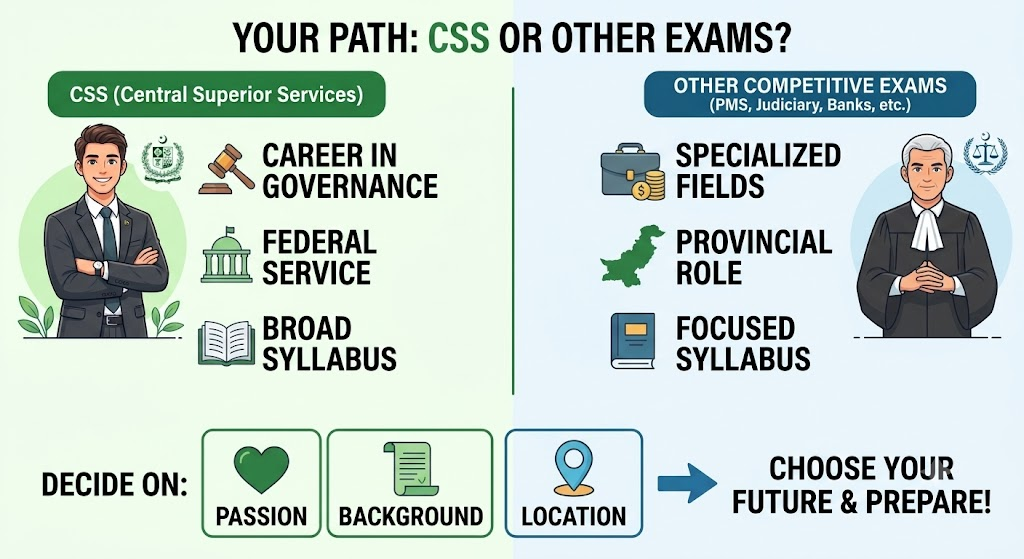
Every year, thousands of ambitious graduates in Pakistan find themselves staring at the same fork in the road: should they prepare for CSS, or is one of the other competitive exams — PMS, PCS, NTS-based recruitment tests, banking exams, or even exams like ISSB and PPSC — a better fit? It's a decision that can shape the next several decades of your career, so it deserves more than a coin flip.
Each competitive exam offers different opportunities, career growth, eligibility criteria, and preparation strategies. The right choice depends on your career goals, interests, educational background, and willingness to handle the challenges each exam presents.
This blog breaks down how CSS compares to the most common alternatives, so you can choose the path that actually matches your goals, strengths, and circumstances.
What is the CSS Exam
The Central Superior Services (CSS) examination is Pakistan's most prestigious competitive examination conducted annually by the Federal Public Service Commission (FPSC). The Central Superior Services (CSS) exam, conducted by the Federal Public Service Commission (FPSC), is the gateway to Pakistan's most prestigious federal civil service groups — including the Pakistan Administrative Service, Foreign Service, Police Service, Customs, Inland Revenue, and more. It's a national-level exam, meaning your posting could take you anywhere in the country, and your career ladder leads toward federal-level influence and policymaking.
Key Features of CSS
- Wide range of subjects: The exam covers compulsory and optional subjects, including English, General Knowledge, Pakistan Affairs, and more.
- Competitive nature: Thousands of candidates apply every year, but only a small percentage succeed.
- Career stability: CSS officers enjoy job security, government benefits, and opportunities for growth.
- Public service: The role involves serving the country and making impactful decisions.
Unlike many government recruitment exams, CSS is not simply a written test. It evaluates a candidate's analytical thinking, communication skills, decision-making ability, and overall personality through multiple stages.
Who Should Consider CSS
- Those interested in government service and administration.
- Candidates who enjoy studying diverse subjects.
- Individuals seeking a stable and respected career.
- People willing to commit to a rigorous preparation process.
Overview of Other Competitive Exams
Apart from CSS, many other competitive exams cater to different career paths. These include exams for banking, engineering, medical fields, teaching, and private sector jobs.
- FPSC General Recruitment Tests
- PPSC, KPPSC, SPSC, and BPSC recruitment exams
- State Bank of Pakistan (SBP) recruitment
- Banking officer recruitment exams
- National Accountability Bureau (NAB)
- FIA recruitment tests
- Public sector organization examinations
These exams generally recruit candidates for specific departments or positions rather than broad administrative services.
The Main Alternatives
Besides CSS, Pakistan offers numerous competitive examinations for government employment at both the federal and provincial levels. These exams provide opportunities to secure stable, well-respected careers in public service across a wide range of departments and organizations. While they may not lead to the broad administrative roles offered through CSS, they are excellent options for candidates seeking specialized positions or a quicker path into government service
PMS (Provincial Management Service)
PMS is essentially the provincial counterpart to CSS, conducted by provincial public service commissions (like PPSC, KPPSC, SPSC, BPSC).
- Scope: Provincial — your career stays within one province.
- Difficulty: Slightly lower competition than CSS, though still rigorous.
- Career ceiling: Good, but generally capped below the federal tier (though provincial secretaries and commissioners hold real power).
- Why people choose it: Less competition, a syllabus that overlaps significantly with CSS (so many candidates prepare for both), and the option to stay closer to home.
PCS / Other Provincial & Departmental Exams
Various provincial and departmental exams (tax inspectors, excise officers, provincial police, etc.) fall into this bracket.
- Scope: Narrow and department-specific.
- Difficulty: Generally easier than CSS/PMS.
- Career ceiling: Moderate — solid, stable jobs but less room for the kind of policy-level influence CSS offers.
- Why people choose it: Faster recruitment cycles, less syllabus to cover, and quicker entry into government service.
Banking & Financial Sector Exams
Exams conducted for State Bank of Pakistan, National Bank, and other financial institutions.
- Scope: Sector-specific, often with good salary packages.
- Difficulty: Moderate, with quantitative and analytical sections rather than essay-heavy papers.
- Career ceiling: Strong in the corporate/financial sense, but distinct from the bureaucratic prestige of CSS.
- Why people choose it: Better starting salaries, less time investment, and a clearer corporate-style career path.
ISSB and Armed Forces Commissions
For those drawn to the military route rather than civil bureaucracy.
- Scope: National, but within the armed forces.
- Difficulty: Different skill set entirely — physical fitness, psychological assessments, and leadership potential matter as much as academics.
- Career ceiling: High within military hierarchy, with strong post-retirement opportunities to.
Comparing CSS with Other Competitive Exams
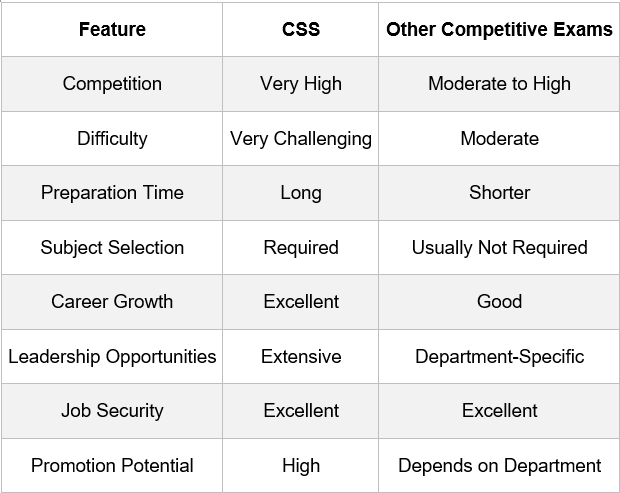
While all competitive exams aim to recruit talented individuals for government service, they differ significantly in terms of eligibility, exam structure, career opportunities, preparation requirements, and long-term growth. Understanding these differences is essential before deciding which exam best suits your ambitions. The comparison below highlights the key aspects of CSS and other competitive exams, helping you make a more informed career choice.
Subject Breadth and Depth
CSS requires knowledge across a broad spectrum of subjects, testing general awareness, analytical skills, and language proficiency. Other exams often focus on specialized knowledge relevant to a particular field.
Career Path and Job Security
CSS offers a government job with long-term security, pension, and perks. Other exams may lead to jobs in private companies or less secure government positions, depending on the sector.
Preparation Time and Effort
CSS preparation can take one to two years due to its extensive syllabus. Other exams might require shorter preparation periods, especially if they focus on a single subject or skill.
Competition and Success Rate
CSS has a low success rate, with only a small fraction of candidates passing. Other exams vary widely; some have higher pass rates, while others remain highly competitive.
Salary and Benefits
CSS officers receive competitive government salaries and benefits. Other exams may lead to jobs with varying pay scales, often depending on the industry and role.
Comparison Table
Feature
CSS
Other Competitive Exams
Competition
Very High
Moderate to High
Difficulty
Very Challenging
Moderate
Preparation Time
Long
Shorter
Subject Selection
Required
Usually Not Required
Career Growth
Excellent
Good
Leadership Opportunities
Extensive
Department-Specific
Job Security
Excellent
Excellent
Promotion Potential
High
Depends on Department
Which One Should You Choose
There's no universally "correct" answer — only the right answer for you. Ask yourself:
- Do I want a federal-level career with the broadest possible influence? → CSS
- Do I want strong prestige and power but prefer staying within my province? → PMS
- Do I want quicker entry into a stable government job with a narrower syllabus? → PCS/Departmental exams
- Do I want strong pay and a corporate-style career without the bureaucratic grind? → Banking exams
- Am I drawn to discipline, leadership, and a military career? → ISSB
Many successful candidates actually prepare for CSS and PMS simultaneously, since the syllabi overlap by 60–70%. This "dual preparation" strategy hedges your risk: if CSS doesn't work out in one attempt, your PMS preparation isn't wasted, and vice versa.
Factors to Consider When Choosing
Choosing between CSS and other competitive exams is not simply about selecting the most prestigious option. It is about finding the career path that aligns with your goals, strengths, interests, and long-term aspirations. Before making a decision, take time to evaluate several key factors that can influence both your preparation journey and future career satisfaction.
Your Interests and Strengths
Choose an exam aligned with your passion and skills. If you enjoy diverse subjects and public service, CSS might be suitable. If you prefer a specialized career, other exams could be better.
Career Goals
Think about where you want to be in five or ten years. CSS offers administrative roles, while other exams might lead to technical, financial, or academic careers.
Preparation Resources
Evaluate the availability of study materials, coaching, and mentorship for each exam. CSS preparation requires comprehensive resources, while other exams might have more focused materials.
Time Commitment
Consider how much time you can dedicate to preparation. CSS demands long-term commitment, while some other exams allow quicker preparation.
Job Location and Lifestyle
CSS jobs often require postings across the country, sometimes in remote areas. Other exams might lead to jobs in urban centers or specific industries.
Tips for Making the Right Choice
- Research thoroughly: Understand the syllabus, exam pattern, and career outcomes.
- Seek advice: Talk to current officers, successful candidates, or career counselors.
- Assess your motivation: Choose a path that keeps you motivated through challenges.
- Plan your preparation: Create a realistic study schedule based on your chosen exam.
- Stay flexible: Be open to adjusting your plans if needed.
Final Thoughts
CSS remains the most prestigious and most challenging route, but "most prestigious" doesn't automatically mean "best for everyone." The right exam is the one that aligns with your strengths, your timeline, your risk appetite, and the kind of life and career you actually want to build. Take an honest inventory of where you stand on each of these dimensions before committing a year or more of your life to preparation — that clarity upfront will save you far more time than it costs.
There is no universally "best" competitive exam—only the one that best matches your goals, strengths, and commitment. CSS offers unmatched opportunities for leadership, influence, and career growth, but it also demands exceptional dedication and consistent preparation. Other competitive exams provide excellent alternatives for candidates seeking stable government careers with a more focused preparation process.
Whichever path you choose, success begins with careful planning, disciplined study, and informed decision-making. For CSS aspirants, one of the earliest and most important decisions is selecting the right optional subjects. Instead of relying on assumptions or popular opinion, using data-driven tools like CSSNorthstar can help you evaluate subject combinations based on your profile and preparation strategy, allowing you to begin your journey with greater confidence.

Sheharyar Ahmad
Founder, CSSNorthstar
Sheharyar Ahmad graduated from LUMS with BSc. (Hons.) in 2010 and topped the CSS Exam 2012 on his first attempt. He is an officer of the Pakistan Administrative Service, having served in Gilgit-Baltistan, Punjab, and Federal governments. He was awarded the Fulbright Scholarship to pursue a Master in Public Policy and Data Analytics from USA in 2022.