CSS Past Papers: A Subject-Wise Breakdown of All 6 Compulsory Subjects (And How to Actually Use Them)
Let me guess. You have downloaded a folder full of CSS past papers, maybe 25 years worth, and you are staring at it thinking, "Now what?" You are not alone. Most aspirants collect past papers like trophies but never figure out how to turn them into a real preparation strategy.
I have spent months analyzing CSS past papers across all compulsory subjects, talked to candidates who cleared and candidates who did not, and noticed something that changed how I approach this exam entirely: the papers are not random. FPSC follows patterns. If you learn to read those patterns, you are not guessing anymore. You are preparing with precision.
This guide breaks down CSS past papers for every compulsory subject, shows you what FPSC actually tests, and gives you a practical framework to use these papers instead of just hoarding them.
Key Takeaways (For the Skimmers)
The CSS written exam has 12 papers worth 1200 marks total. Six of those papers are compulsory, worth 600 marks collectively, and every single candidate must attempt them regardless of their optional subject choices. You need a minimum of 40% in each compulsory subject to survive.
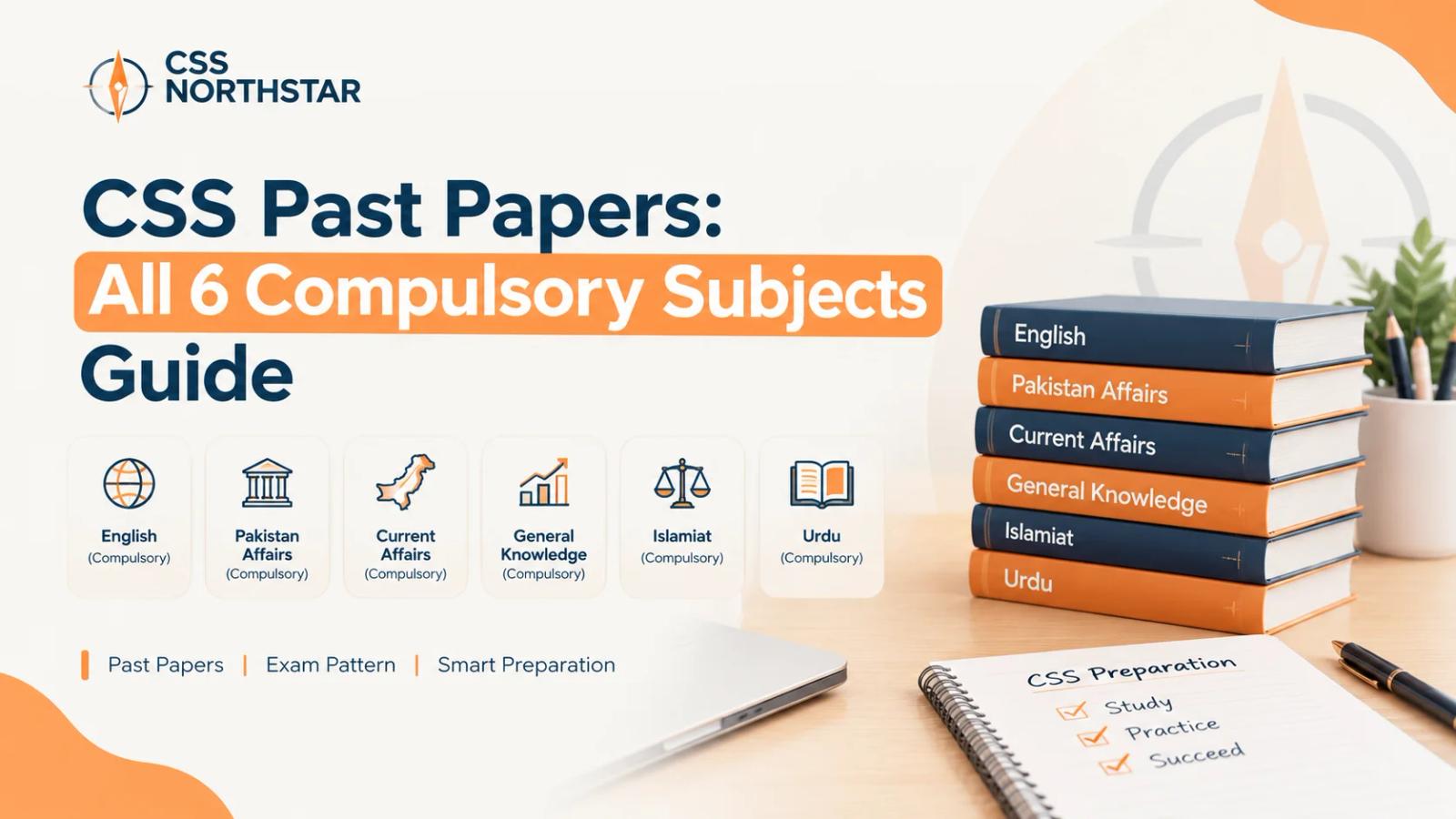
The six compulsory subjects are English Essay, English Precis and Composition, General Science and Ability, Current Affairs, Pakistan Affairs, and Islamiat. Each carries 100 marks.
Past papers from 2000 to 2025 reveal that FPSC has gradually shifted from factual recall toward analytical and conceptual evaluation. Memorizing content is no longer enough. You need to understand how to apply what you know under exam conditions. For context on how this played out most recently, the CSS 2025 compulsory results breakdown makes the scoring reality painfully clear.
Who This Guide is For (And Who It is Not For)
This is for you if you are a CSS aspirant who wants to go beyond surface-level preparation. Maybe you are starting from zero and feeling overwhelmed by the sheer volume of material. Maybe you are a repeater who scored well in optionals but got knocked out by a compulsory subject. Either way, this guide gives you a subject-wise roadmap.
This is not a substitute for actually solving papers. If you read this and do not pick up a pen afterward, it will not help you.
Why CSS Past Papers Matter More Than You Think
Here is a number that should wake you up. In the CSS 2025 exam, only 355 candidates out of 12,792 cleared the written stage. That is a pass rate of roughly 2.67%. The year before, CSS 2024 saw 397 pass out of 15,602, a rate of 2.48%. And CSS 2023? Only 401 out of 13,800, barely 2.96%.
The pass rate has not crossed 3.1% in recent years. This is not an exam you can wing.
Most candidates fail not because they lack knowledge, but because they misunderstand what FPSC is looking for. Past papers are the closest thing you have to reading the examiner's mind. They show you the format, the difficulty level, the types of questions that get repeated, and the shift in what FPSC values over time.
I have seen aspirants who read 15 books but never solved a single past paper under timed conditions. They walk into the exam hall and freeze. Then I have seen candidates with half the reading but who practiced past papers religiously. Guess who performs better?
Subject 1: English Essay (100 Marks)
The English Essay paper is one of the most feared compulsory papers, and for good reason. You get a choice of topics and must write one comprehensive essay. FPSC is testing your reasoning, argument structure, and ability to present complex ideas clearly. In CSS 2025, the English Essay paper averaged just 26.1 out of 100, against a 40% pass requirement.
What past papers reveal: When you look at CSS English Essay past papers from 2000 to 2024, recurring thematic clusters become obvious. Governance, socio-economic development, education policy, gender issues, environmental concerns, globalization, and international relations appear again and again. FPSC favors analytical, idea-based topics over descriptive ones.
The mistake most candidates make: They prepare by memorizing quotations and pre-written paragraphs. FPSC examiners can spot a recycled essay from a mile away. What actually scores marks is a clear thesis, logical flow, original thinking, and specific examples.
How to use past papers here: Pick one essay topic every week from a past paper. Write it under timed conditions (three hours). Then compare your structure and argument quality with model essays from toppers. You will notice your weak spots fast. Are you struggling with introductions? Are your arguments circular? Past papers expose these issues in real time.
Subject 2: English Precis and Composition (100 Marks)
This paper tests grammar, vocabulary, comprehension, precis writing, and sentence construction. It is the most "skill-based" compulsory paper. You either know how to write a precis or you do not.
What past papers reveal: The sentence correction section has remarkably consistent patterns. Subject-verb agreement errors, misplaced modifiers, incorrect prepositions, and tense confusion appear year after year. The pair of words section (tested since 1972) has a pool of frequently repeated pairs. Same goes for idioms, which have been part of the paper since the 1970s. You can verify all of this by browsing the English Precis and Composition past papers archive.
A practical observation: I noticed that candidates who focused only on grammar rules without solving actual past paper sentences often got confused during the exam. The reason is that FPSC does not test textbook grammar in isolation. They embed errors in complex sentences that require you to read carefully. Practicing with real past paper questions trains your eye in a way that grammar books alone cannot.
How to use past papers here: Get a compiled collection of sentence corrections, pair of words, and idioms from past papers spanning at least 20 years. Flag every item that repeats more than twice. That is your priority list. For precis and comprehension, practice the actual passages from past papers, not random ones from the internet.
Subject 3: General Science and Ability (100 Marks)
This paper often catches science and non-science students off guard for different reasons. Science students underestimate the "ability" portion (quantitative reasoning, logical puzzles, analytical skills). Non-science students panic at the science content.
What past papers reveal: The paper typically splits between everyday science questions (physics, chemistry, biology, technology, space, environment) and mental ability questions (mathematics, logical reasoning, analytical puzzles). FPSC tends to ask applied science questions rather than deep theoretical ones. They want to know if you understand how the world around you works. The General Science and Ability past papers show the reasoning half is where repeat question patterns are most visible.
The honest truth: This is one of those papers where past paper MCQs repeat frequently. I have personally cross-referenced General Science MCQs from multiple years and found significant overlap. Questions about inventions, scientific instruments, diseases, vitamins, and environmental phenomena cycle through the papers. If you solve 15 years of past paper MCQs with proper explanations (not just memorized answers), you will cover a large chunk of what FPSC can throw at you.
How to use past papers here: Solve past paper MCQs year by year. After each year, mark questions you got wrong. Look up the underlying concept, not just the answer. For the mental ability section, practice quantitative reasoning and logical puzzles from past papers under timed conditions. Speed matters here. If you need book recommendations for this and other compulsory subjects, make sure you pick resources that align with what FPSC actually asks.
Subject 4: Current Affairs (100 Marks)
This is both the most unpredictable and the most predictable compulsory subject. Unpredictable because the content changes with global events every year. Predictable because the themes FPSC asks about remain remarkably stable.
What past papers reveal: FPSC consistently asks about Pakistan's foreign policy, major international organizations (UN, WTO, SAARC, SCO, OIC), regional geopolitics (especially Pakistan-India, Pakistan-China, Middle East dynamics), and global economic trends. The MCQ portion often covers international agreements, summits, and appointments from the year preceding the exam. The Current Affairs past papers confirm this: the events change every year but the way FPSC frames them does not.
What worked for candidates I know: Two aspirants I spoke with had completely different approaches. One followed 10 newspapers daily and burned out. The other read one quality newspaper consistently, maintained a monthly current affairs notebook organized by theme (Pak-India, Pak-China, economy, climate, international orgs), and solved past paper questions weekly. The second candidate scored 15 marks higher. If you are preparing for the upcoming cycle, this guide on CSS Current Affairs 2027 expected topics and monthly strategy breaks it down further.
How to use past papers here: Go through the last five years of Current Affairs papers. List every topic that appeared. You will find that roughly 60 to 70% of question themes repeat year after year; only the specific events change. Build your preparation around those recurring themes and update them with current events.
Subject 5: Pakistan Affairs (100 Marks)
Pakistan Affairs is the backbone of the CSS exam. It covers the country's history, political system, economy, society, culture, and constitutional development. The failure rate in this subject alone has been alarmingly volatile: it hit 71% in 2020 and sat at around 46% in 2021.
What past papers reveal: FPSC has steadily moved from asking purely factual questions ("When was the Lahore Resolution passed?") toward analytical ones ("Critically analyze the role of the 18th Amendment in Pakistan's federal structure"). If your preparation is limited to dates and events, you are preparing for a paper FPSC stopped setting years ago. Browse the Pakistan Affairs past papers from 2000 to 2024 and you will see the shift for yourself.
A framework that works: When analyzing Pakistan Affairs past papers, I categorize questions into five clusters: constitutional and political development, economic challenges, foreign policy, social issues (education, health, population), and ideological foundations. Every year, FPSC pulls from all five. If you are weak in any one cluster, you have a gap that can cost you 20 to 25 marks.
How to use past papers here: Do not just read the questions. Attempt them in writing. Pakistan Affairs rewards structured, analytical answers with specific examples, not vague generalizations. Practice converting a past paper question into a proper outline before writing the full answer. This builds the habit of organized thinking under pressure.
Subject 6: Islamiat (100 Marks)
For Muslim candidates, Islamiat is compulsory. Non-Muslim candidates can opt for an alternative paper. This subject covers the fundamentals of Islam, the life of the Prophet (PBUH), Islamic jurisprudence, the ethical system, and the relationship between Islam and modern challenges.
What past papers reveal: FPSC asks a mix of MCQs (basic Islamic knowledge, Quranic references, Hadith, important Islamic events) and descriptive questions (Islamic economic system, social justice in Islam, comparison of Islamic and Western thought). The MCQ portion has a well-defined pool. Many questions about key Islamic dates, battles, treaties, and Surah names rotate across years. You can verify this pattern across the Islamic Studies past papers going back to 2000.
A common pitfall: Some candidates treat Islamiat as easy marks and prepare it casually. Then they score 35 out of 100 and fail the compulsory threshold. This happens more often than people admit. The descriptive portion requires you to connect Islamic principles to contemporary issues, which demands actual preparation, not assumptions.
How to use past papers here: Solve all available Islamiat MCQs from past papers and memorize the factual pool (it is finite and repetitive). For descriptive questions, practice writing answers that bridge classical Islamic principles with modern relevance. FPSC rewards depth over breadth here.
The "Past Paper Practice Framework" I Recommend
After going through years of CSS past papers across all compulsory subjects, here is the step-by-step approach that works:
Step 1 (Weeks 1 to 2): Download CSS past papers for all six compulsory subjects from 2015 to 2024. CSSNorthstar hosts 155 original FPSC compulsory papers from 2000 to 2024 that you can read in your browser or download as PDFs for free. Just read through them without solving. Your goal is to understand the format, mark distribution, and the types of questions FPSC asks.
Step 2 (Weeks 3 to 6): Start solving one paper per week under strict timed conditions. Alternate between subjects. After each paper, mark yourself honestly. Identify which question types you struggle with.
Step 3 (Weeks 7 to 10): Go deeper into older papers (2000 to 2014) for pattern mining. List repeated MCQs, recurring essay themes, and frequently tested topics across all subjects.
Step 4 (Ongoing): Build a "high-yield" document for each subject containing only the most frequently tested facts, themes, and question patterns. This becomes your revision weapon in the final weeks.
Past Papers Are Half the Battle. Subject Selection Is the Other Half.
Here is something most aspirants overlook while buried in compulsory paper preparation: compulsory subjects are the same 600 marks for everyone. The other 600 marks come from your optional subjects, and that is where the real strategic decisions happen. The CSS 2025 results data shows that most candidates score within a narrow range on compulsory papers. It is the optional subjects that create separation on the merit list.
Choosing the wrong optionals can sink you regardless of how well you prepare the compulsory side. If you have not already locked in your optional subjects with confidence, the CSSNorthstar subject selection assessment matches your academic background, strengths, and domicile against six years of real FPSC data to recommend the combination most likely to work for someone like you. It is the one decision worth getting right before you start burning months on preparation. You can also read their data-backed guide to choosing CSS optional subjects if you want to understand the methodology first.
Frequently Asked Questions
How many years of CSS past papers should I solve?
At minimum, solve the last 10 years (2015 to 2024) thoroughly. For MCQ-heavy papers like General Science and Islamiat, going back 15 to 20 years is worth it because MCQs repeat frequently. CSSNorthstar's compulsory past papers archive goes back to 2000 and covers all six subjects.
What are the passing marks for CSS compulsory subjects?
You need at least 40% in each compulsory subject (40 out of 100), 33% in each optional subject, and 50% in the overall aggregate. Falling short in even one compulsory paper means elimination regardless of your other scores.
Can I clear CSS by only studying past papers?
No. Past papers are a preparation tool, not a replacement for content knowledge. You need to study core books and materials first, then use past papers to test your understanding, identify patterns, and practice exam technique.
Are CSS past papers available in PDF format?
Yes. CSSNorthstar hosts 155 original FPSC compulsory past papers in PDF from 2000 to 2024, free with a sign-in. These are original papers, not re-typed versions, which matters for accuracy.
Do CSS paper patterns change frequently?
The core structure has remained consistent for years. Six compulsory subjects, 100 marks each, a mix of MCQs and descriptive questions. However, FPSC has been shifting from factual recall toward more analytical and conceptual questions over the last decade. If you are new to CSS preparation, understanding this shift early saves you from wasting months on the wrong study approach.
Your Next Step
Stop collecting past papers and start using them. Pick the compulsory subject you feel weakest in right now. Head to the CSSNorthstar past papers page, download the last five years of that subject, and solve one this week under real exam conditions: timed, no phone, no notes. Mark yourself, identify your gaps, and then target those gaps with focused study.
The CSS exam is not about knowing everything. It is about knowing what FPSC asks and proving you can deliver it under pressure. Past papers are the bridge between your preparation and the actual exam hall. Cross it.

Sheharyar Ahmad
Founder, CSSNorthstar
Sheharyar Ahmad graduated from LUMS with BSc. (Hons.) in 2010 and topped the CSS Exam 2012 on his first attempt. He is an officer of the Pakistan Administrative Service, having served in Gilgit-Baltistan, Punjab, and Federal governments. He was awarded the Fulbright Scholarship to pursue a Master in Public Policy and Data Analytics from USA in 2022.