Top 5 Mistakes Aspirants Make in CSS MPT Mocks: And How to Avoid Them
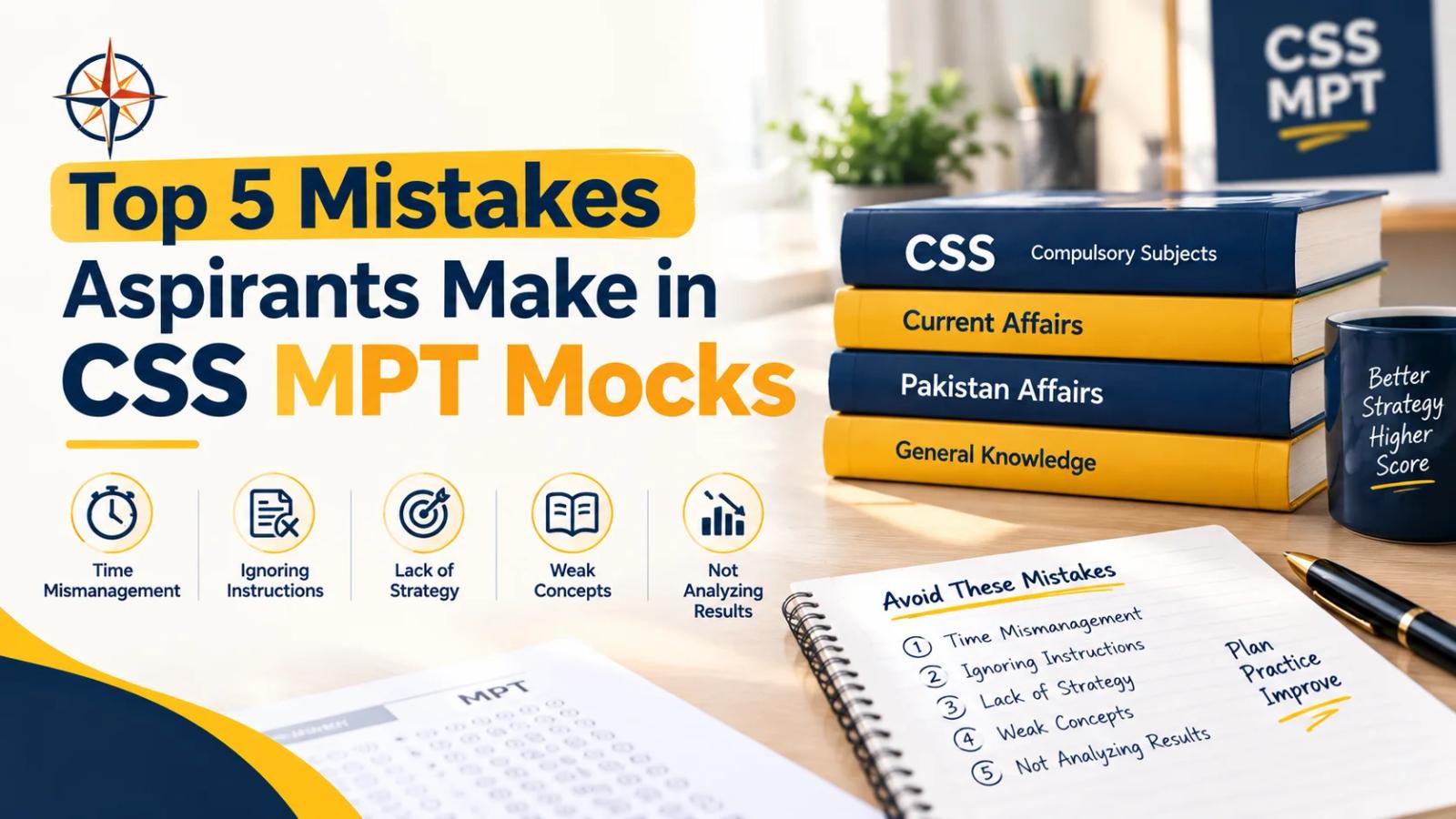
A mock test that does not change how you prepare is just a practice test you sat through.
Most CSS aspirants take one or two MPT mocks, check their score, feel either relieved or anxious, and then go back to reading the same material in the same way. That is the core problem. The mock is not the point. What you do with the result is the point.
After reviewing patterns in how aspirants prepare for and respond to MPT mocks, the same five mistakes appear consistently. Each one is fixable. None of them require more preparation time to fix. They require smarter use of the time you already have.
The CSS MPT — A Quick Orientation
Before getting into the mistakes, one clarification that matters.
The CSS MPT 2027 is 200 marks across seven sections: English Grammar, Vocabulary, and Comprehension (50 marks), General Science and Ability (60 marks), Current Affairs, Pakistan Affairs, and Islamic Studies (20 marks each), and Urdu Grammar and Translation (20 marks). The qualifying threshold is 33 percent — 66 correct answers out of 200.
There is no negative marking.
This structure has specific implications for every mistake below. The marks distribution is not equal across subjects and that asymmetry is one of the most exploited advantages available to a prepared candidate.
Mistake 1 — Treating the Mock Score as a Pass or Fail Rather Than a Diagnostic
This is the most expensive mistake and the most common.
An aspirant scores 74 on a mock test. They feel comfortable because 74 is above 66. They move on without analysing which questions they got wrong, why they got them wrong, or what the subject-wise breakdown of their score looks like.
What they missed: that 74 built on 48 English marks and only 26 marks across General Science and Ability. If the real exam produces the same GSA score of 26, they are comfortably passing. But GSA is 60 marks. The mock just told them they are getting less than half of the highest-weighted section in the test, and they walked past that information.
The mock test is a diagnostic tool. Treat it like one. After every mock attempt, before looking at your total, look at your section-wise scores. Write them down. The section where you are weakest relative to its marks weightage is where your next preparation block goes. Not the section where you feel most anxious. The section where the data says you are leaving the most marks.
What to do after your next mock:
Write out your score in this format: English X/50, GSA X/60, Current Affairs X/20, Pakistan Affairs X/20, Islamic Studies X/20, Urdu X/20. Then ask one question: if I had scored 50 percent instead of my actual score in each section, where would I gain the most marks? That is your preparation priority.
Mistake 2 — Skipping Questions They Are Uncertain About
There is no negative marking in the CSS MPT. This is explicitly stated in the FPSC rules.
Despite this, a significant number of aspirants skip questions they are not certain about, intending to return to them later. Some run out of time and never return. Others second-guess correct instincts when they do return. Both outcomes produce the same result: marks left behind for no structural reason.
The math is simple. If you guess randomly on a four-option MCQ, you have a 25 percent chance of getting it right. Over 40 skipped questions, random guessing produces roughly 10 additional marks. Over a full attempt with no skips, an informed guess — where you can eliminate even one option — produces a better hit rate than random. There is no scenario in a zero-negative-marking exam where leaving a question blank is better than guessing.
The preparation implication: practise making a decision on every question within your time limit, even when uncertain. The habit of marking your best guess and moving on is a skill that needs to be built in mocks before exam day. Aspirants who develop the instinct to always select an answer — even an uncertain one — consistently outscore equally prepared aspirants who leave blanks.
What to do in your next mock:
Attempt every single question. Mark questions you are uncertain about with a light mark in your question paper so you can review them if time permits. But always fill the answer bubble. If you run out of time for review, you have still answered 200 questions. The aspirant who left 20 blanks answered 180.
Mistake 3 — Preparing for Mocks the Same Way They Prepared for the Previous One
This mistake is a close cousin of Mistake 1 but different in a specific way.
Aspirants take a mock, identify they are weak in GSA, spend two weeks on GSA preparation, then take another mock. Their GSA score improves slightly. Their Current Affairs score drops because they neglected it for two weeks. They spend the next two weeks on Current Affairs. Cycle repeats.
This is called reactive preparation. It is better than no analysis at all, but it has a ceiling. You are always preparing for the last mock's weaknesses rather than systematically building across all sections simultaneously.
The alternative is sequential preparation with maintenance. After your diagnostic from Mistake 1, rank your seven sections from weakest to strongest relative to their marks weightage. Spend 60 percent of your preparation time on the bottom two sections. Spend 40 percent maintaining competence in the sections already performing well. Do not completely abandon strong sections — they decay without practice, which is the reactive preparation trap.
GSA is almost always the section that catches aspirants off guard because it is the highest-weighted section (60 marks) and requires both factual recall and quantitative reasoning. Most aspirants underweight it in preparation because it feels like a mix of subjects without a clear textbook. Treat it as your primary preparation target unless your mock scores already show you comfortably above 35 marks in that section.
The preparation structure that works:
Week 1: All sections, identify your bottom two. Week 2 onwards: 60 percent of daily preparation time on bottom two sections, 40 percent on the rest. Mock every two weeks: recalibrate the 60/40 split based on updated scores.
Mistake 4 — Not Timing Each Section During the Mock
The CSS MPT gives you a fixed total time for 200 questions. Most aspirants approach it as a single pool of time — they work through the paper and manage time overall. This produces a predictable failure pattern: they spend too long on difficult English or GSA questions early in the paper, rush through Pakistan Affairs and Current Affairs at the end, and produce weaker scores in sections that would have been their highest marks with adequate time.
Each section has a natural time budget based on its marks value and question difficulty.
A working time allocation for the MPT:
- English (50 marks, ~40 questions): 22 minutes
- GSA (60 marks, ~50 questions): 28 minutes
- Current Affairs (20 marks, ~17 questions): 10 minutes
- Pakistan Affairs (20 marks, ~17 questions): 10 minutes
- Islamic Studies (20 marks, ~17 questions): 10 minutes
- Urdu (20 marks, ~17 questions): 10 minutes
- Buffer for review: 10 minutes
Total: approximately 100 minutes. FPSC sets the actual exam duration — use this as a proportional allocation framework, not an absolute.
The point is not that you must follow this exact split. The point is that going into a mock with a section-wise time plan and tracking it during the attempt gives you information about where you are losing time in addition to where you are losing marks. A section where your score is low AND your time overrun is high is a different problem than a section where your score is low but your time allocation is correct. The first needs comprehension work. The second needs factual recall work. You cannot distinguish them without timing your sections.
What to change immediately:
In your next mock, set a timer for each section. Write your section start time in the margin when you move to a new section. At the end of the mock, record how long each section actually took versus your target. This data tells you as much as your score.
Mistake 5 — Taking Mocks Too Close to the Exam Date Without Time to Act on the Results
A mock test result is only useful if you have enough preparation time remaining to do something about what it tells you.
Taking your first mock one week before the CSS MPT gives you a diagnostic snapshot with no time to act on it. The anxiety it produces is real. The preparation value is minimal. You know your weaknesses more precisely than before, but you cannot materially address them in five days across 200 marks of content.
The optimal mock test schedule works backwards from your exam date:
Six weeks before the exam: First mock. This gives you five weeks to act on serious weaknesses identified in Mistake 1's diagnostic. It is also the point at which many aspirants discover their GSA or Urdu preparation is significantly behind where they assumed.
Three weeks before the exam: Second mock. At this point you should see measurable improvement in your Week 1 diagnostic weak points. If you do not, the two weeks of preparation between mocks were not targeted at the right material.
One week before the exam: Third mock. At this distance, the purpose of the mock shifts. You are no longer trying to build competence. You are confirming your section-wise scores are stable, practicing your time allocation, and reducing exam-day cognitive friction by making the format familiar. This mock should produce a lower anxiety response than the first one because you have already done this twice.
The CSSNorthstar MPT mock test is designed for exactly this three-stage schedule. 200 MCQs in the FPSC pattern, timed, with subject-wise results so you can run the Mistake 1 diagnostic immediately after each attempt. At PKR 1,000 per attempt, three attempts across six weeks costs PKR 3,000 — less than a single week of academy classes — and produces actionable data at each stage.
The Pattern Underneath All Five Mistakes
Every mistake above shares the same root: treating a mock test as a performance rather than a process.
The score tells you how you are doing. The section breakdown tells you what to fix. The time data tells you why you are getting certain sections wrong. The timing of the mock relative to your exam date tells you whether you have enough runway to act on what you learned.
An aspirant who takes three well-spaced mocks, runs a proper diagnostic after each one, and adjusts their preparation accordingly will consistently outperform an equally talented aspirant who takes five mocks, checks the total score each time, and continues the same preparation routine.
The MPT has a 33 percent qualifying threshold. That sounds low. The aspirants who fail it are not the ones who know less than the ones who pass. They are the ones who prepared less systematically — often because they had the same amount of preparation time but used it less deliberately.
With the MPT 2027 on October 10, you have limited weeks remaining. How you use those weeks matters more than how many hours you put in.
Attempt the CSSNorthstar MPT mock test here and run the Mistake 1 diagnostic on your result before you close the tab.
Frequently Asked Questions
How many mock tests should I take before the CSS MPT?
Three well-spaced mocks — at six weeks, three weeks, and one week before the exam — produce better preparation outcomes than a higher number of mocks taken randomly. Each mock should generate a diagnostic that changes what you study next. If a mock is not changing your preparation, you are not using it correctly.
Is the CSS MPT difficult to clear?
The qualifying threshold is 33 percent (66 marks out of 200). The difficulty is not the threshold but the breadth — 200 questions across seven subjects require consistent preparation across all sections simultaneously. Candidates who focus heavily on one or two subjects and neglect others often fall short despite strong performance in their strong areas.
What is the most important section to prepare for in the CSS MPT?
General Science and Ability (60 marks) has the highest weightage and is consistently the most underestimated section. Most aspirants allocate preparation time proportional to how anxious a subject makes them rather than how many marks it represents. GSA makes many aspirants least anxious because it feels familiar — and is therefore least prepared. That combination produces the most preventable mark losses in the test.
Does my MPT score affect my CSS merit position?
No. The MPT is a qualifying gate, not a merit component. You pass it or you do not. Your score does not carry forward to the written examination merit list. The written examination results, psychological assessment, and viva voce determine the final merit position. The MPT's only function is determining who sits the written exam.
If you have not yet decided on your six optional subjects for the CSS 2027 written examination, the period between MPT registration and the October 10 test date is the right time to finalise that decision. The written examination application opens November 10 and subject selection forms part of that application.
The CSSNorthstar assessment uses six years of FPSC result data to match your academic background, domicile, and target service group to the optional subject combination most likely to work for your specific profile. It takes less than 20 minutes and is free to complete.

Sheharyar Ahmad
Founder, CSSNorthstar
Sheharyar Ahmad graduated from LUMS with BSc. (Hons.) in 2010 and topped the CSS Exam 2012 on his first attempt. He is an officer of the Pakistan Administrative Service, having served in Gilgit-Baltistan, Punjab, and Federal governments. He was awarded the Fulbright Scholarship to pursue a Master in Public Policy and Data Analytics from USA in 2022.