How to Crack the CSS MPT in 30 Days: Subject-Wise Weightage and Strategy
Most CSS MPT guides assume you have four to six months to prepare. If you are reading this, you probably do not. You have thirty days, maybe less, and you need a plan that tells you exactly where to put your time, not a general encouragement to "study hard across all subjects."
This guide gives you that plan. It is built around one core idea that most aspirants ignore under time pressure: your preparation time should match the exam's marks distribution, not your personal comfort level with each subject.
If you have more time than 30 days, this plan still works. Just repeat weeks 3 and 4 until your exam date arrives.
The CSS MPT Marks Breakdown — Where Your Time Should Actually Go
The CSS MPT is 200 marks total, with a qualifying threshold of 33 percent (66 marks). There is no negative marking, which changes your strategy significantly and is covered later in this guide.
Here is the approximate marks distribution across sections:
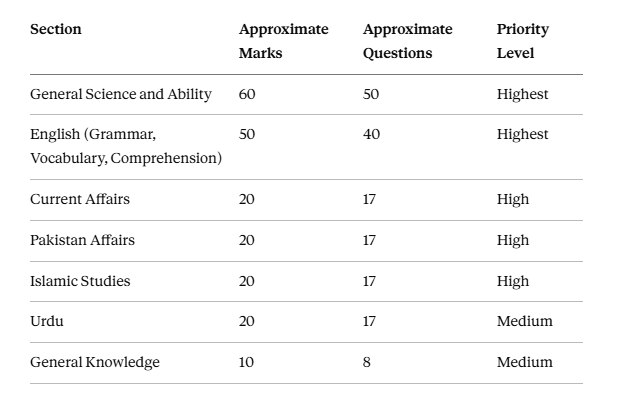
The single most important number in this table: General Science and Ability is worth more than any other section, yet it is the section most aspirants prepare for last and least. This is backwards. If you take away one thing from this entire guide, it should be this: GSA is your highest-leverage subject, not your lowest-priority one.
English is the second-highest weighted section and the one most aspirants assume they already know because they speak English daily. Speaking English and scoring well on grammar, vocabulary precision, and comprehension under exam pressure are different skills. Do not skip English preparation because you feel confident in conversation.
Current Affairs, Pakistan Affairs, and Islamic Studies are equally weighted at 20 marks each, but they behave differently in preparation. Current Affairs requires ongoing reading discipline because it changes weekly. Pakistan Affairs and Islamic Studies are more stable bodies of knowledge that reward focused study sessions.
The 30-Day Plan — Week by Week
Week 1 (Days 1 to 7): Diagnostic and Foundation
Do not start by opening books randomly. Start by finding out where you actually stand.
Day 1 to 2: Take a full-length mock test under timed conditions. This is not optional. Without a diagnostic, you are preparing based on assumptions about your own weaknesses, and those assumptions are usually wrong. The CSSNorthstar MPT mock test gives you 200 MCQs in the FPSC pattern with an instant subject-wise breakdown, which is exactly what you need at this stage.
Day 3: Review your mock test results section by section. Write down your score in each of the seven areas. Identify your two weakest sections relative to their marks weightage. A low score in a 10-mark section matters less than a low score in a 60-mark section.
Day 4 to 7: Begin General Science and Ability foundation work. Cover basic physics, chemistry, and biology concepts at an O-Level standard. Cover fundamental mathematics: percentages, ratios, basic algebra, and simple probability. Do 20 practice questions daily from this section specifically.
Week 2 (Days 8 to 14): English and GSA Intensive
This week is deliberately built around your two highest-weighted sections.
Days 8 to 10: English grammar deep dive. Work through common error types: subject-verb agreement, tense consistency, preposition usage, and parallel structure. These four categories account for the majority of English grammar questions in past MPT papers.
Days 11 to 12: Vocabulary building through active practice, not passive reading. Learn 15 to 20 words daily using synonym and antonym drills rather than flashcard memorization alone. Test yourself by using each new word in a sentence.
Days 13 to 14: Continue GSA with a focus on logical and analytical reasoning. This includes pattern recognition, basic syllogisms, and quantitative reasoning problems. These question types reward practice more than raw knowledge, so repetition matters here more than reading.
Daily throughout Week 2: Continue 15 to 20 minutes of Dawn editorial reading every single day. This single habit builds English comprehension, Current Affairs knowledge, and Pakistan Affairs context simultaneously. Skipping this to save time is the single most common mistake aspirants make under time pressure.
Week 3 (Days 15 to 21): Current Affairs, Pakistan Affairs, and Islamic Studies
Days 15 to 17: Current Affairs. Build a structured summary of the past 12 to 18 months covering Pakistan's foreign policy developments, major regional events (Afghanistan, India, China-Pakistan relations), and significant international events. Organize this by theme, not chronologically, because MPT questions test conceptual understanding, not date recall.
Days 18 to 19: Pakistan Affairs. Cover constitutional history, the ideological foundation of Pakistan, and major political developments since 1947 at a summary level. You do not need textbook-depth knowledge for MPT. You need recognition-level familiarity with names, events, and dates.
Days 20 to 21: Islamic Studies. Focus on the life of the Prophet Muhammad (PBUH), the four Rightly Guided Caliphs, basic principles of Islamic jurisprudence, and commonly referenced Quranic themes. This section rewards familiarity over depth for MPT purposes specifically, unlike the written examination where the same subject requires much deeper preparation.
Daily throughout Week 3: Continue your GSA and English practice at a maintenance level, roughly 20 minutes each per day, so your Week 2 gains do not decay while you focus on these three subjects.
Week 4 (Days 22 to 28): Urdu, General Knowledge, and Full Mock Practice
Days 22 to 23: Urdu grammar and translation practice. Focus on common grammatical structures and English-to-Urdu translation exercises, since this is where most marks are lost in this section rather than in comprehension.
Days 24: General Knowledge — a broad review of world geography, major international organizations, and general awareness topics. This is only 10 marks, so limit your time investment here to one focused day.
Days 25 to 28: Full-length mock tests under strict timed conditions, at least two to three attempts across these four days. This is the stage where the goal shifts from building knowledge to building exam-day performance: managing your time per section, developing the instinct to answer every question given there is no negative marking, and reducing the unfamiliarity that causes otherwise well-prepared candidates to underperform on the actual day.
Days 29 to 30: Consolidation, Not New Material
Do not introduce new content in the final two days. This is consistently where over-preparation becomes counterproductive. Review your notes from each section briefly. Get proper sleep both nights. Confirm your admission certificate is downloaded and your exam centre location and reporting time are clear.
Why No Negative Marking Changes Your Entire Strategy
The CSS MPT has no negative marking. This single rule should influence how you spend your last week of preparation and how you behave inside the exam hall.
If you are unsure between two options on a question, guess rather than leave it blank. A blank answer guarantees zero marks. A guess between two options gives you a 50 percent chance at that mark. Across 200 questions, this difference compounds into several additional marks purely from decision discipline, not additional knowledge.
Practice this discipline during your Week 4 mock tests specifically. Train yourself to mark an answer for every single question, even ones you are uncertain about, before time runs out.
The Mistake That Costs Aspirants the Most Marks
If you take away only one additional point beyond the weightage table above, it is this: aspirants consistently under-prepare for GSA because it feels unfamiliar and over-prepare for subjects like Islamic Studies and Pakistan Affairs because those subjects feel more comfortable and culturally familiar.
Comfort is not the same as marks value. GSA is worth 60 marks. Islamic Studies and Pakistan Affairs are worth 20 marks each. If your preparation time allocation does not reflect this difference, you are optimizing for how preparation feels rather than for your actual score.
For a deeper breakdown of the specific errors aspirants make in mock test preparation and how each one is fixed, see Top 5 Mistakes Aspirants Make in CSS MPT Mocks.
What This Plan Assumes and What to Do If You Have Less Time
This 30-day structure assumes you are starting from a reasonable baseline: you can read and comprehend English at an intermediate level, you have some prior exposure to Current Affairs through regular newspaper reading, and you can commit 4 to 5 hours of daily preparation time.
If you have less than 30 days remaining, compress the plan rather than skip sections. Reduce Week 1's diagnostic period to two days instead of seven, and shorten Week 3's subject coverage to summary notes rather than full review. Do not skip the diagnostic mock test entirely, no matter how little time you have. Preparing blind, without knowing your actual weak points, is worse than a shorter but targeted plan.
If your exam date is October 10, 2026, and you are reading this with only two weeks left, compress this into a 14-day version: combine Weeks 1 and 2 into one accelerated week, combine Weeks 3 and 4 into the second week, and skip straight to mock test practice by day 10. For the complete registration timeline and what happens after MPT, see the CSS MPT 2027 Registration Guide and the rescheduling notice confirming the October 10 date.
Frequently Asked Questions
What is the most important subject to prepare for CSS MPT?
General Science and Ability carries the highest marks weightage at 60 out of 200. It is also the subject most aspirants underestimate because it does not map cleanly to a single familiar textbook. Prioritizing GSA preparation time in proportion to its marks value is the single highest-leverage decision in MPT preparation.
Can I really prepare for CSS MPT in 30 days?
Yes, provided you have a reasonable baseline in English comprehension and some existing familiarity with Current Affairs through regular reading. Thirty days is sufficient for a structured, weightage-based plan, though it requires consistent daily effort rather than sporadic study sessions.
Should I guess on CSS MPT questions I am unsure about?
Yes. There is no negative marking on the CSS MPT, so leaving a question blank guarantees zero marks while guessing gives you a real chance at scoring. Never leave a question unanswered, even if you are uncertain.
How many mock tests should I take before the actual MPT?
At minimum, three to four full-length mock tests spaced across your preparation period, with the final one to two attempts happening in your last week under strict timed conditions. Mock tests are not just practice, they are diagnostic tools that tell you where your remaining preparation time should go.
Your MPT preparation time is limited and irreplaceable. Spend it in proportion to how the exam is actually scored, not in proportion to which subjects feel most comfortable.
Once you clear the MPT, the next decision that matters is your optional subject selection for the written examination, which opens for application on November 10. The CSSNorthstar assessment uses six years of FPSC result data to match your academic background, domicile, and target service group to the subject combination most likely to work for your specific profile. It takes less than 20 minutes and is free.

Sheharyar Ahmad
Founder, CSSNorthstar
Sheharyar Ahmad graduated from LUMS with BSc. (Hons.) in 2010 and topped the CSS Exam 2012 on his first attempt. He is an officer of the Pakistan Administrative Service, having served in Gilgit-Baltistan, Punjab, and Federal governments. He was awarded the Fulbright Scholarship to pursue a Master in Public Policy and Data Analytics from USA in 2022.