CSS Economics Paper Pattern and Marks Distribution: Complete Guide
Economics is a 200-mark optional subject in the CSS examination, divided into two papers of 100 marks each. The syllabus covers microeconomics, macroeconomics, money and banking, public finance, international trade, economic development, and Pakistan's economy.
But knowing the syllabus is only part of the preparation. You also need to understand how the examiner turns these topics into questions, which concepts you can explain confidently, and where your preparation is weakest.
The most useful starting point is to study the official syllabus alongside actual FPSC question papers. This guide explains the paper structure, the marks distribution, what each paper covers, and how to use past papers to prepare more effectively.
CSS Economics Paper Pattern at a Glance
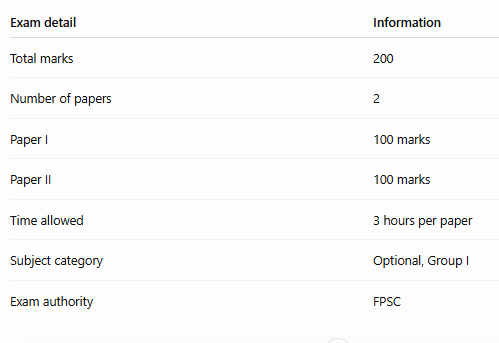
Economics carries 200 marks, so it represents a substantial part of your optional-subject score. You need to prepare both papers, understand the prescribed syllabus, and practise answering questions within the examination time.
For the official subject outline, consult the FPSC CSS Economics syllabus.
CSS Economics Marks Distribution
The 200 marks are divided equally between Paper I and Paper II. Each paper has its own syllabus, so candidates need to prepare both rather than relying on strength in only one area.
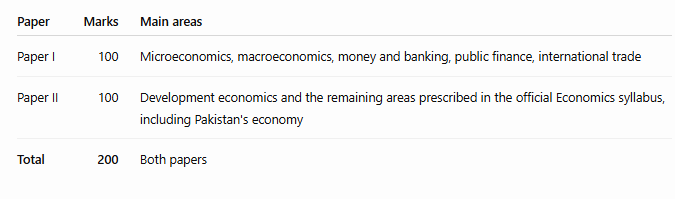
This is the official paper-wise distribution. It does not mean that every topic within a paper receives a fixed number of marks. Individual questions and their allocation can vary between examination years.
Candidates should also distinguish between the marks available in a paper and the marks they can realistically earn. A topic may look familiar in a textbook, but answering an analytical question on it requires a different level of preparation.
CSS Economics Paper I: Syllabus and Main Topics
Paper I covers five major areas of economics: microeconomics, macroeconomics, money and banking, public finance, and international trade. These areas form the foundation for understanding economic decisions, market behaviour, government policies, and international economic relationships.
1. Microeconomics
Microeconomics examines how consumers and firms make decisions and how prices and quantities are determined in different markets.
The FPSC syllabus includes:
- Consumer behaviour
- Market demand and supply
- Elasticity of demand and supply
- Static and comparative static analysis
- Partial and general equilibrium
- Theory of the firm
- Producer equilibrium
- Pricing of factors of production
How to prepare: Do not stop at learning definitions. Practise explaining how changes in price, income, costs, or market conditions affect consumers and producers. Be comfortable interpreting relevant graphs and explaining the assumptions behind economic models.
For example, a question about price elasticity requires more than a definition. A sound answer should explain how responsiveness is measured and why it matters for consumers, producers, or government policy.
2. Macroeconomics
Macroeconomics studies the economy as a whole, including output, employment, inflation, consumption, and aggregate demand.
Important areas include:
- National income accounting
- Consumption function
- Multiplier and accelerator
- Components of aggregate demand
- Labour demand and supply
- Unemployment
- Equilibrium income and output
- Different schools of macroeconomic thought
- Inflation
How to prepare: Focus on the relationships between concepts. For instance, understand how a change in investment can affect aggregate demand and equilibrium income through the multiplier process. Be able to explain the assumptions behind a model rather than memorising its formula alone.
When a question asks you to evaluate an economic policy, distinguish between its theoretical effect and the conditions under which that effect may change.
3. Money and Banking
This area covers monetary theory, the banking system, central bank functions, interest rates, and monetary policy.
The syllabus includes:
- Functions of money
- Quantity theory of money
- Fisher and Cambridge formulations
- Systems of note issue
- Credit creation
- Functions of central banks
- Instruments of credit control
- Monetary policy targets and transmission mechanisms
- Demand and supply of money
- Liquidity preference
- Term structure of interest rates
- IS-LM analysis
- Time value of money and capital structure
How to prepare: Study monetary concepts as connected processes. Be able to explain how central bank actions may influence interest rates, credit conditions, aggregate demand, and inflation. Also understand the limitations of monetary policy rather than assuming that every policy instrument produces the same result in every economic situation.
4. Public Finance
Public finance deals with government revenue, expenditure, taxation, public debt, and the economic consequences of fiscal decisions.
Key topics include:
- Government expenditure
- Sources of government revenue
- Taxes and non-tax revenue
- Tax incidence
- Public debt and repayment
- Deficit financing
- Privatisation
- Welfare economics
- Fiscal policy
- General equilibrium analysis
How to prepare: Connect the theory to public policy. For example, a question about taxation may require you to explain who ultimately bears the tax burden, how incentives may change, and what the policy means for government revenue and income distribution.
For Pakistan-related applications, use reliable and dated evidence where relevant. Avoid presenting a budget figure or economic statistic without identifying the period it represents.
5. International Trade
International trade examines why countries trade, how trade affects economic growth, and how governments regulate international economic activity.
The syllabus covers:
- Comparative advantage
- Factor endowment theory
- Trade and economic growth
- Trade restrictions
- Trade policy
- Economic integration
- Balance of payments
- Foreign exchange
- International monetary systems
- Customs unions
- Colonialism, imperialism, and international trade
How to prepare: Learn the logic behind each theory and understand what it explains. Comparative advantage, for example, concerns the relative opportunity costs of producing goods. It should not be reduced to the claim that a country with lower production costs always benefits from every form of trade.
For applied questions, connect the theory to issues such as trade deficits, exchange-rate movements, export competitiveness, and trade restrictions where relevant.
CSS Economics Paper II: What Candidates Need to Study
Paper II covers the remaining areas prescribed by FPSC, including economic development and Pakistan's economy. Consult the official syllabus for the complete list of topics and their exact scope.
Economic development
Development economics examines how economies improve living standards and address structural problems that affect growth.
Prepare the prescribed concepts, theories, and measures of economic development. Understand the distinction between economic growth and broader development, and how factors such as investment, productivity, employment, poverty, and human capital relate to economic performance.
The key is to explain relationships rather than memorise isolated definitions. If a question asks why an economy struggles to develop, organise your answer around causes, mechanisms, consequences, and possible policy responses.
Pakistan's economy
Pakistan's economic conditions provide an important context for applying economic concepts. Prepare the areas covered by the official syllabus and understand the economic reasoning behind issues such as inflation, taxation, public debt, unemployment, productivity, investment, and external-sector pressures wherever they fall within the prescribed topics.
Use evidence carefully. A statistic from one fiscal year cannot automatically describe the current situation. When you include figures, identify their year and source, and explain what they demonstrate.
How to approach applied questions
A strong applied answer connects economic theory with the issue in the question. Consider this structure:
- Define the relevant economic concept.
- Explain the mechanism or theory.
- Apply it to the problem being discussed.
- Support your reasoning with an appropriate graph, equation, example, or verified evidence.
- Evaluate the implications and reach a direct conclusion.
Use this as a preparation framework, not a claim about a fixed FPSC marking formula. The requirements of an actual answer depend on the question.
What Do CSS Economics Past Papers Tell You?
The syllabus establishes the range of material you need to study. Past papers show how FPSC has tested that material in particular examinations.
CSSNorthstar's Economics past papers archive currently lists 20 original papers from 2001 to 2021. The archive provides a starting point for comparing questions across years, although it does not include every examination year.
Do not use the archive simply to memorise questions. Use it to build a clearer picture of your preparation.
1. Identify the concept behind each question
A question can use different wording while testing a familiar economic principle. Record the underlying concept, the relevant syllabus section, and the type of reasoning required.
This helps you prepare a concept thoroughly instead of memorising one answer that fits only one question.
2. Separate theory questions from applied questions
Some questions may focus on explaining a theory or model. Others may require evaluation, comparison, or application.
Practise each type separately. For a theory question, focus on the model, its assumptions, and its explanation. For an applied question, show how the model relates to the issue and discuss relevant limitations.
3. Track topic coverage before deciding what to prioritise
Create a simple spreadsheet with the examination year, paper, question topic, syllabus section, and question type. After reviewing the papers available, count how often each area appears in your sample.
This produces a documented view of the papers you actually reviewed. It does not establish what FPSC will ask next year, and missing years can affect the results. Use the analysis to identify gaps in your preparation, not to discard parts of the official syllabus.
4. Test your ability to finish the paper
Complete a past paper under timed conditions and review the result honestly. Did you understand the question? Did you have enough knowledge to answer it? Did you spend too long on one response? Could you explain your reasoning clearly?
Your answers will show whether the next stage of preparation should focus on subject knowledge, analytical writing, diagrams, calculations, or time management.
CSS Economics Results: Is It a Safe Optional Subject?
Economics should not be selected solely because someone describes it as a scoring subject. CSSNorthstar's published analysis of CSS 2025 provides a more concrete starting point for evaluating the examination data.
According to the site's CSS 2025 Economics results analysis, 341 candidates appeared for Economics, nine cleared the written stage, and four were allocated. The reported mean score was 34.5% of the subject's 200 marks. These figures describe one examination cycle, not a guaranteed outcome for future candidates.
The distinction matters. A subject's average score, the number of candidates who pass the written examination, and the number eventually allocated are different measures. Allocation also depends on overall merit and the applicable selection process.
Use these figures alongside your own academic background, understanding of economic theory, and performance on practice questions. One year's results cannot determine whether Economics is the right choice for you.
How to Prepare for CSS Economics More Effectively
A useful preparation plan should help you identify what you know, what you cannot yet explain, and what needs more practice.
Step 1: Map the official syllabus. Divide both papers into their prescribed sections and record the topics you have covered.
Step 2: Study concepts before memorising answers. Learn the theory, assumptions, diagrams, and applications relevant to each topic.
Step 3: Review previous questions. Use the Economics past papers archive to connect syllabus topics with actual examination questions.
Step 4: Write complete answers. Practise explaining theories and applying them to the question. Use diagrams or equations when they genuinely help.
Step 5: Attempt timed papers. Work under examination conditions and record where you lose time or struggle to explain a concept.
Step 6: Revise based on evidence. Return to weak areas identified in your practice. Do not repeatedly study familiar material while avoiding the topics you find difficult.
For a wider view of optional-subject selection, you can also visit the CSSNorthstar past papers hub, which organises papers by compulsory and optional subjects.
Frequently Asked Questions
How many marks does CSS Economics carry?
Economics carries 200 marks, divided into Paper I and Paper II, each worth 100 marks.
How long is each CSS Economics paper?
The standard duration is three hours per paper. Follow the instructions issued for the relevant examination.
What topics are included in Economics Paper I?
The FPSC syllabus includes microeconomics, macroeconomics, money and banking, public finance, and international trade.
Are the same Economics questions repeated every year?
There is no guarantee that a question will repeat. Reviewing previous papers helps you recognise concepts, understand question styles, and test your preparation, but you should not rely on predictions as a substitute for studying the syllabus.
Where can I find CSS Economics past papers?
Use the CSS Economics past papers archive to access the available year-wise papers.
Should I choose Economics if I have never studied it before?
Your academic background is relevant, but it is not the only factor. Review the syllabus, attempt questions from both papers, and assess whether you can understand the models and explain economic arguments. Compare that experience with the requirements of your other optional subjects before deciding.
The most effective way to prepare for CSS Economics is to combine the official syllabus with actual question papers and regular written practice. Learn the concepts, understand how they connect, and test your ability to explain them under time pressure.
Use past papers to find gaps in your knowledge, not to predict the examination with certainty. And when deciding whether Economics belongs in your optional combination, consider your own command of the subject alongside the available examination data.
Start with the CSS Economics past papers archive, select a paper, and use it to assess your current level before building your revision plan.

Sheharyar Ahmad
Founder, CSSNorthstar
Sheharyar Ahmad graduated from LUMS with BSc. (Hons.) in 2010 and topped the CSS Exam 2012 on his first attempt. He is an officer of the Pakistan Administrative Service, having served in Gilgit-Baltistan, Punjab, and Federal governments. He was awarded the Fulbright Scholarship to pursue a Master in Public Policy and Data Analytics from USA in 2022.