AI-Based CSS Subject Selection: A Game-Changer for Rural and Small City Aspirants
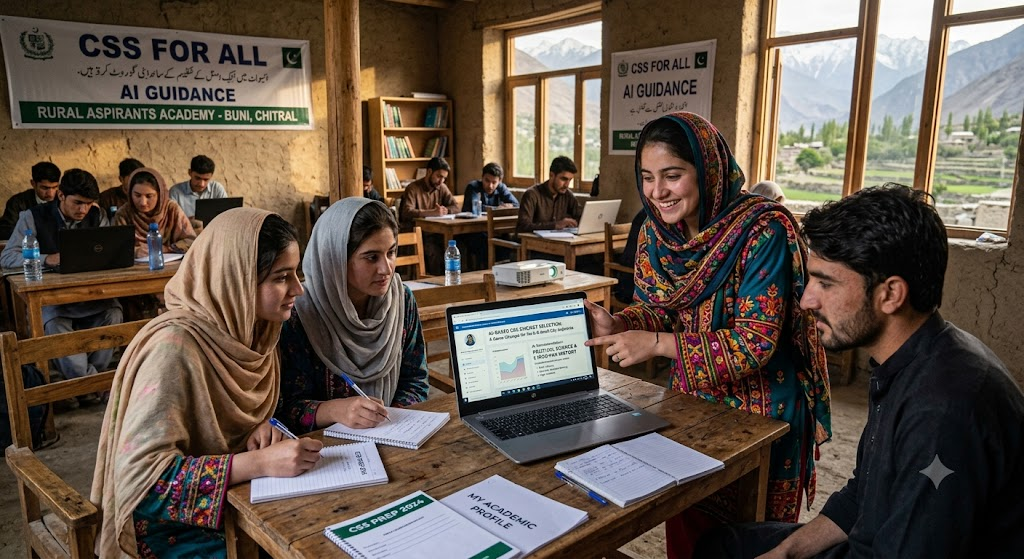
Choosing the right subjects for the Central Superior Services (CSS) exam can be a daunting task, especially for aspirants from rural areas and small cities. Limited access to guidance, resources, and mentorship often leaves them uncertain about which subjects to pick, affecting their chances of success.
This is one of the most overlooked problems in CSS preparation. Aspirants in big cities have access to seasoned mentors, coaching academies, and seniors who've already cracked the exam. They get guided subject combinations based on years of pattern analysis. Rural and small city candidates rarely have this luxury. They often pick subjects based on guesswork, hearsay, or whatever a local tutor happens to teach. The challenge isn't a lack of ambition or ability—it's a lack of access. This is exactly where AI-based CSS subject selection is changing the game.
AI-based CSS subject selection is not just another educational technology. It is a powerful tool that helps level the playing field by providing data-driven, personalized recommendations to aspirants regardless of where they live. By using data-driven tools instead of guesswork, aspirants from underserved regions can finally access the same quality of strategic guidance that was once reserved for students with privileged access to top-tier mentorship. This article explores how AI is transforming CSS preparation for rural and small city aspirants, making opportunities more accessible and achievable.
Why Subject Selection Matters
CSS optional subjects are not just another checklist item. They influence workload, scoring potential, overlap with other papers, and the efficiency with which an aspirant can prepare over months. A poor combination can create unnecessary pressure, while a well-chosen combination can make preparation more focused and sustainable.
For rural and small-city aspirants, the stakes are even higher because they often rely on limited advice from local circles. That advice may be sincere, but it is not always data-driven or aligned with the candidate’s strengths. AI tools can help bridge this gap by turning scattered advice into a structured decision-making process.
How AI Enhances CSS Subject Selection
AI-based subject selection tools usually work by analyzing several inputs at once, such as educational background, subject interest, writing comfort, and preparation goals. Instead of following generic “best subjects” lists, the system can suggest combinations that better fit the individual candidate. Rather than relying on generalized advice, AI focuses on the unique profile of each aspirant.
Personalized Recommendations Without a Mentor
One of the biggest advantages AI brings is personalized guidance at scale. A rural student in Dera Ismail Khan or Tharparkar doesn't need to know a retired CSS officer personally. An AI-powered tool can ask a series of structured questions — about your academic history, interest areas, and study capacity — and output a ranked list of recommended subjects.
This democratizes mentorship. What was once gatekept by geography and social networks is now accessible to anyone with a smartphone and internet connection
Data-Driven Insights
By analyzing historical data on subject difficulty, pass rates, and scoring trends, AI tools provide insights that help aspirants avoid subjects with low success rates or high dropout rates
For example, AI analysis might reveal that Political Science and International Relations as a combination shows strong score correlation for humanities graduates, while Pure Mathematics tends to drag down overall scores for students without a strong quantitative background.
Reducing the "Coaching Academy Gap"
The coaching academy ecosystem is concentrated in a few urban centers. Annual fees for quality institutes can run into hundreds of thousands of rupees unaffordable for most rural families.
AI platforms offer subject analysis features at a fraction of the cost. This reduces the financial barrier and ensures that economically disadvantaged candidates don't make uninformed decisions just because they couldn't afford a course.
Equal access to guidance
One of the most powerful advantages of AI is reach. A student in Abbottabad, Swat, Mardan, Khairpur, or a village town can access the same structured subject-selection framework as someone in a major city. That does not remove every barrier, but it closes an important one: access to informed support.
Helping Candidates Avoid "Subject Traps"
Certain subjects appear attractive on the surface but are notoriously difficult to score well in without specialized preparation. AI tools, trained on historical CSS data, can flag these patterns and warn aspirants before they commit.
Common "subject traps" for unprepared rural candidates include:
- Subjects with highly subjective marking and low transparency
- Subjects where paper setters are known for unexpected scope changes
- High-competition subjects where the average score ceiling is lower
Matching Subject Combinations to Career Goals
CSS leads to different service groups — Foreign Service of Pakistan (FSP), Pakistan Administrative Service (PAS), Police Service of Pakistan (PSP), and more. CSSNorthstar AI tools can map recommended subject combinations to specific service group allocation patterns, helping candidates align their academic choices with their career aspirations from day one.
Real-World Impact: A Practical Example
Consider a B.Sc. student from a small town in southern Punjab with a strong background in mathematics but no exposure to law or international relations.
Without AI guidance, this student might pick subjects simply because a local coaching center offers them — regardless of fit.
With AI-based CSS subject selection, the same student could be guided toward subjects with quantitative or analytical components (such as Governance & Public Policies or Public Administration combined with a science-aligned subject), based on actual aptitude matching rather than local availability.
Example:
Ahmed, a BSc Physics graduate from Bahawalpur, always assumed he should take Physics and Mathematics as CSS optionals. An AI tool analyzed his profile and revealed:
- Physics has historically low average scores in CSS
- His graduation GPA indicates stronger analytical than mathematical ability
- A combination of Economics + Sociology + Public Administration has significantly higher success rates for candidates with this profile
He switched his plan, scored well in the new combination, and cleared CSS on his first attempt.
Not every AI tool is useful. A credible CSS subject-selection platform such as CSSNorthStar should explain why a subject is recommended, not just list options. It should also show syllabus relevance, overlap with other papers, and the likely difficulty of preparation based on the student’s profile.
Actionable Tips for Using AI Tools in CSS Subject Selection
Here's how to get the most out of AI-based subject selection tools:
Be honest in your input: AI recommendations are only as good as the data you feed in. Accurately report your graduation subject, areas of strength, and available study hours.
Cross-reference with past papers: Once AI shortlists subjects, download the last 5 years of past papers for each and assess whether you can engage meaningfully with the content.
Don't ignore your genuine interest: AI can optimize for scores, but sustained motivation matters. If you genuinely love a subject, that passion can overcome data-based hesitation.
Combine AI insight with mentor feedback when possible. Even a single consultation with an experienced CSS qualifier can validate AI-generated suggestions.
Don't chase "easy" subjects blindly: A subject with a high pass rate but no personal interest can backfire over months of study.
Reassess after your first mock: After attempting mock papers in your AI-recommended subjects, revisit the tool with your performance data for refinement.
Why This Matters Beyond Just Subject Selection?
AI-based CSS subject selection isn't just a convenience feature — it's part of a bigger movement toward making CSS preparation fairer for everyone, regardless of where they live. This is the exact gap CSS Northstar AI was built to close.
Rural and small city aspirants typically face three recurring barriers:
- Limited access to updated study material — While urban candidates get the latest book recommendations and trend analysis through coaching networks, rural students often rely on outdated guides passed down from previous attempts.
- Fewer experienced mentors nearby — A qualified CSS mentor in a small town is rare. Most aspirants outside major cities have no one to validate their subject choices or strategy.
- Higher cost-to-benefit ratio for relocating to cities for coaching — Moving to Lahore or Islamabad for coaching means rent, travel, and living expenses many families simply can't justify for an exam with no guaranteed outcome.
CSS Northstar AI doesn't pretend to solve every one of these challenges. No tool can replace a good mentor or a well-stocked library. But it does solve the one problem that quietly derails more attempts than any other: starting the journey with the wrong strategy.
By analyzing academic background, aptitude, and FPSC's own historical result trends, CSS North Star AI gives every aspirant — whether they're in Islamabad or a remote tehsil in Baluchistan — the same starting advantage: a subject selection built on evidence, not guesswork.
That's the real shift here. It's not about replacing hard work. It's about making sure that hard work is pointed in the right direction from day one.
The Future of AI in Competitive Exam Preparation
The impact of artificial intelligence on education is only beginning to emerge. Beyond subject selection, future AI-powered tools may offer personalized study schedules, performance tracking, resource recommendations, and adaptive learning pathways.
These innovations have the potential to transform how students prepare for competitive examinations. As AI continues to evolve, aspirants from rural and small-city backgrounds will gain even greater access to resources that were once available only to a select few.
This technological shift represents a significant opportunity to create a more inclusive and accessible educational ecosystem.
Conclusion
The dream of cracking CSS is not reserved for students born in big cities with wealthy parents and coaching academy memberships. It belongs to every aspirant with the discipline, the drive, and the right information.
AI-based CSS subject selection is not a shortcut. It's a smart starting line — one that equips rural and small-city candidates with the data-driven clarity that urban aspirants have long taken for granted.
By choosing subjects backed by evidence rather than assumption, you spend your study hours on subjects where your potential is highest. That efficiency, compounded over months of preparation, can be the difference between a passing score and a top-20 result.

Sheharyar Ahmad
Founder, CSSNorthstar
Sheharyar Ahmad graduated from LUMS with BSc. (Hons.) in 2010 and topped the CSS Exam 2012 on his first attempt. He is an officer of the Pakistan Administrative Service, having served in Gilgit-Baltistan, Punjab, and Federal governments. He was awarded the Fulbright Scholarship to pursue a Master in Public Policy and Data Analytics from USA in 2022.